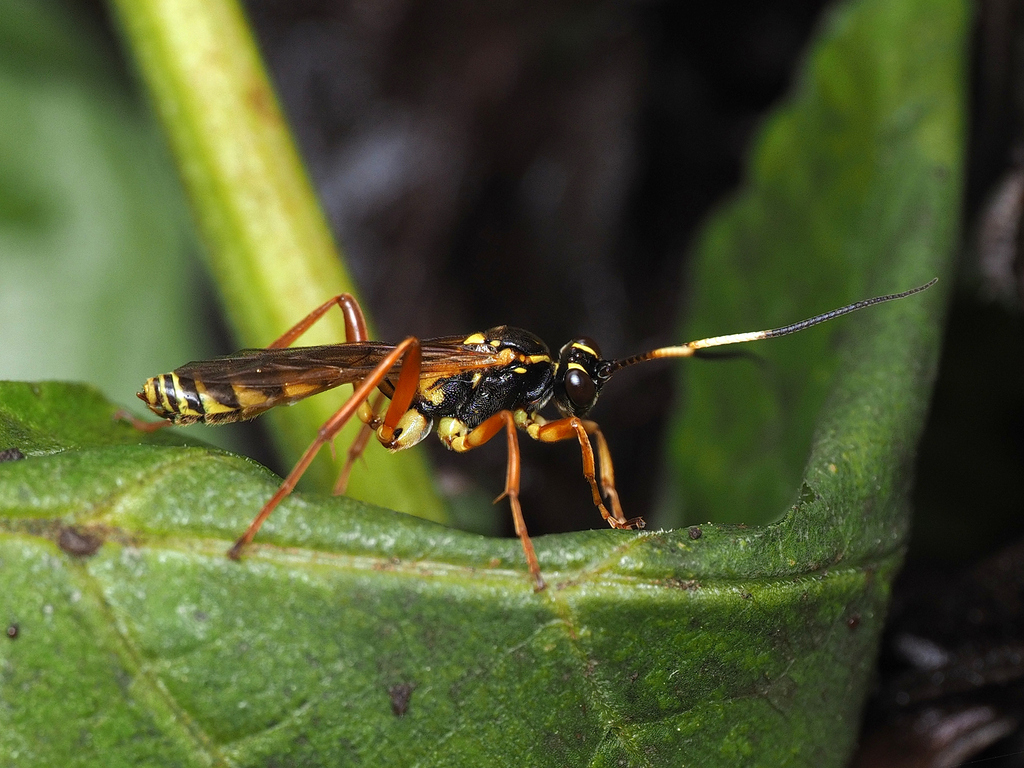
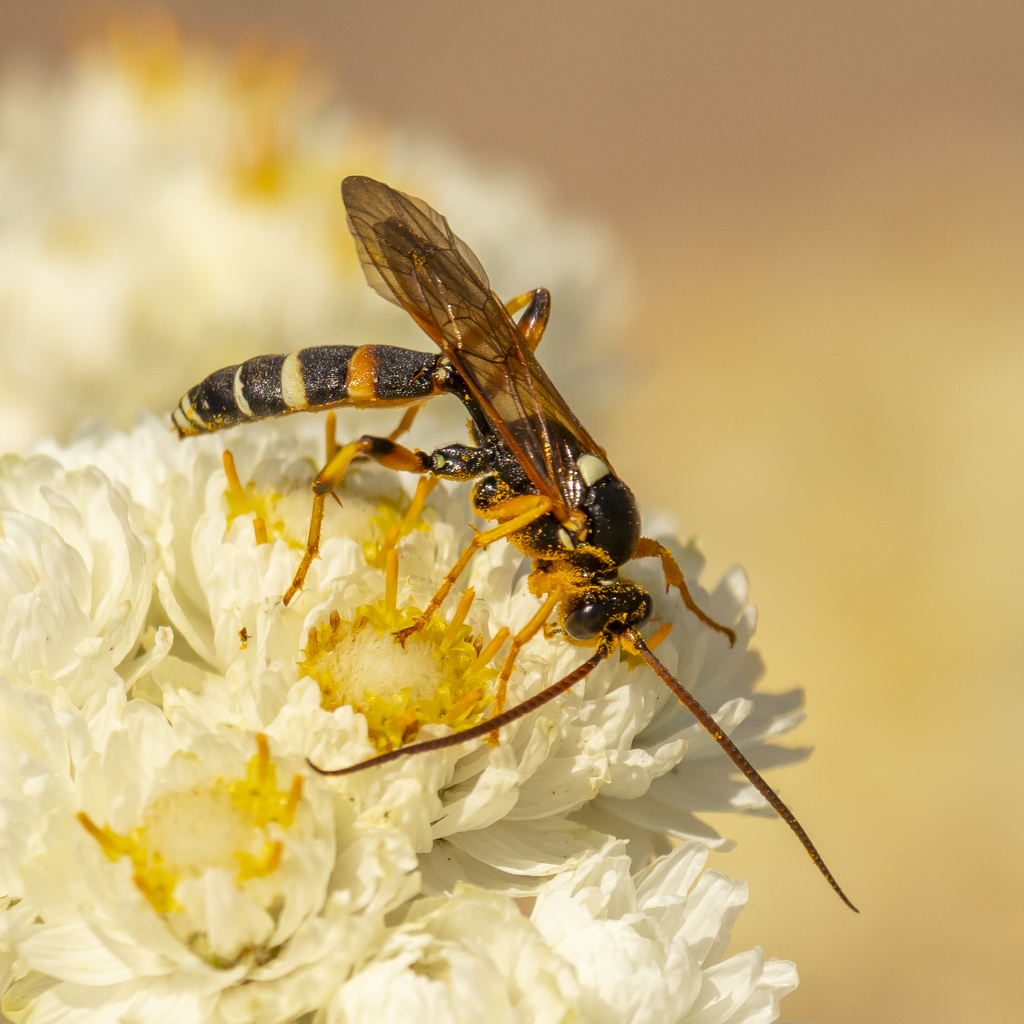
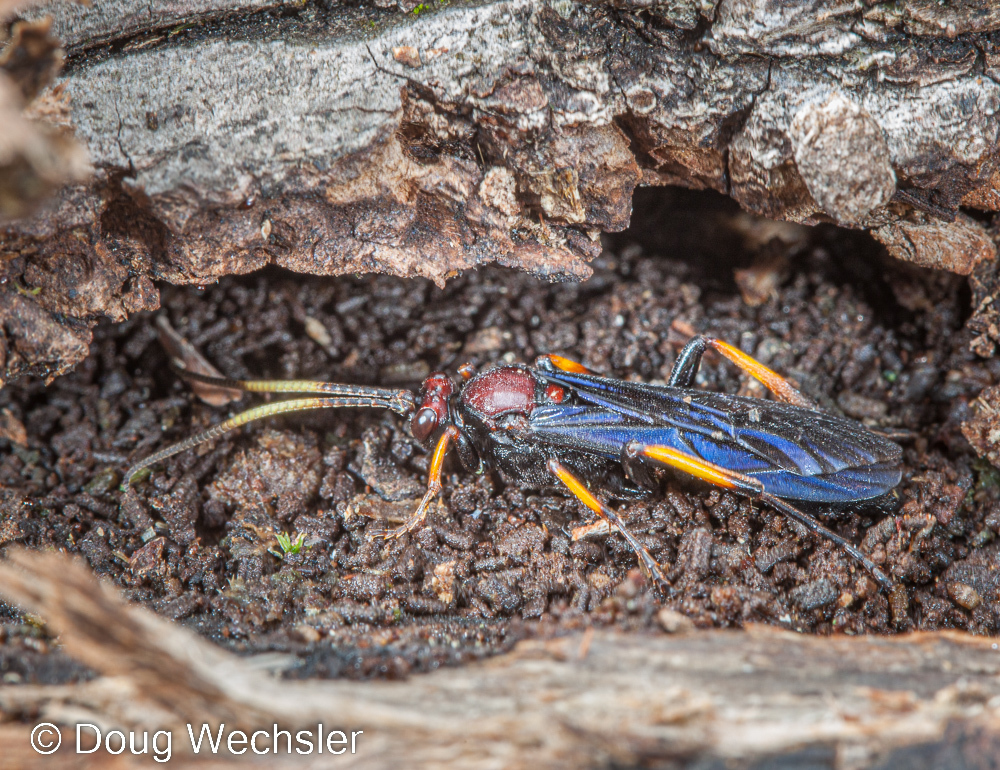
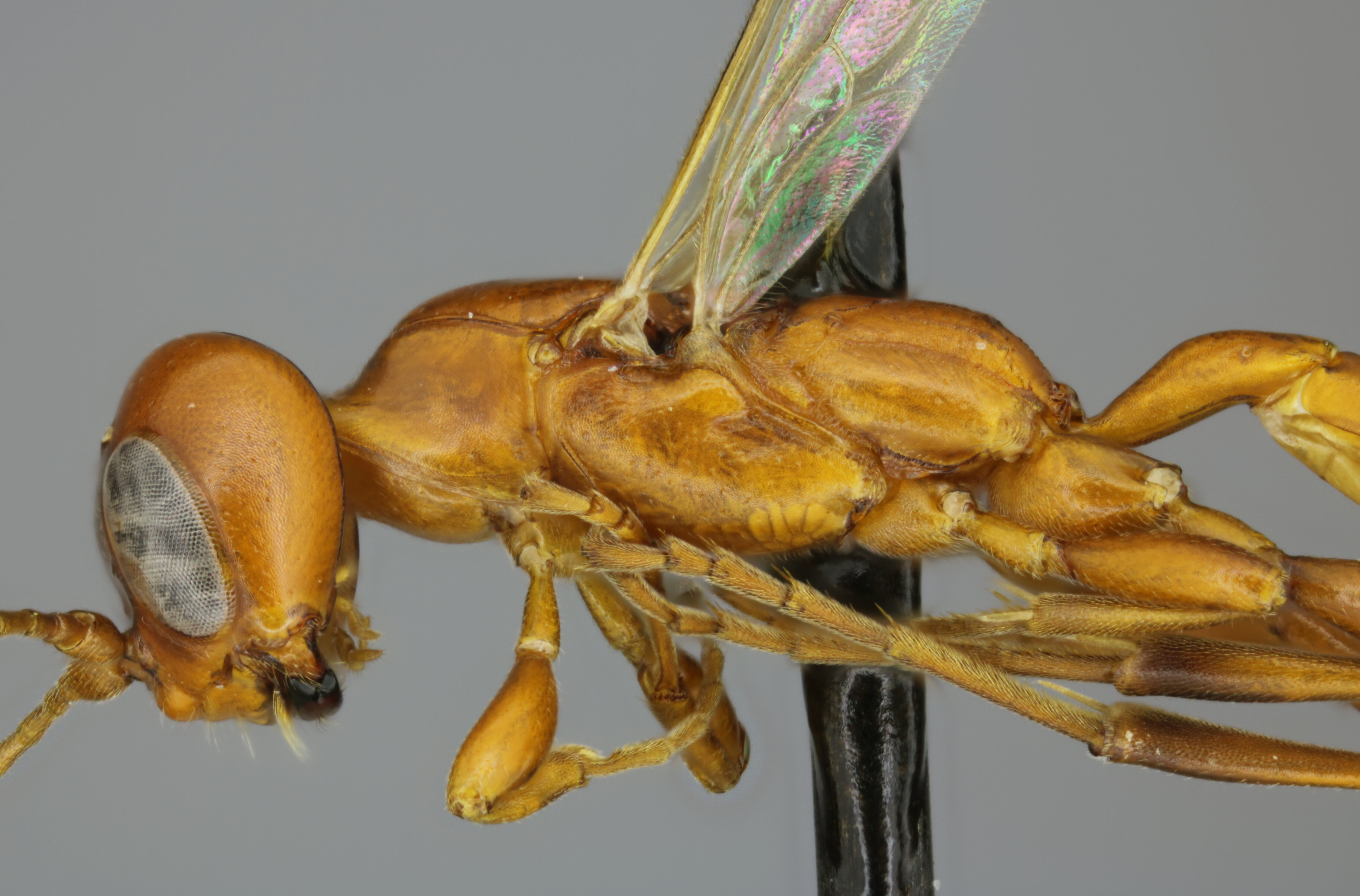
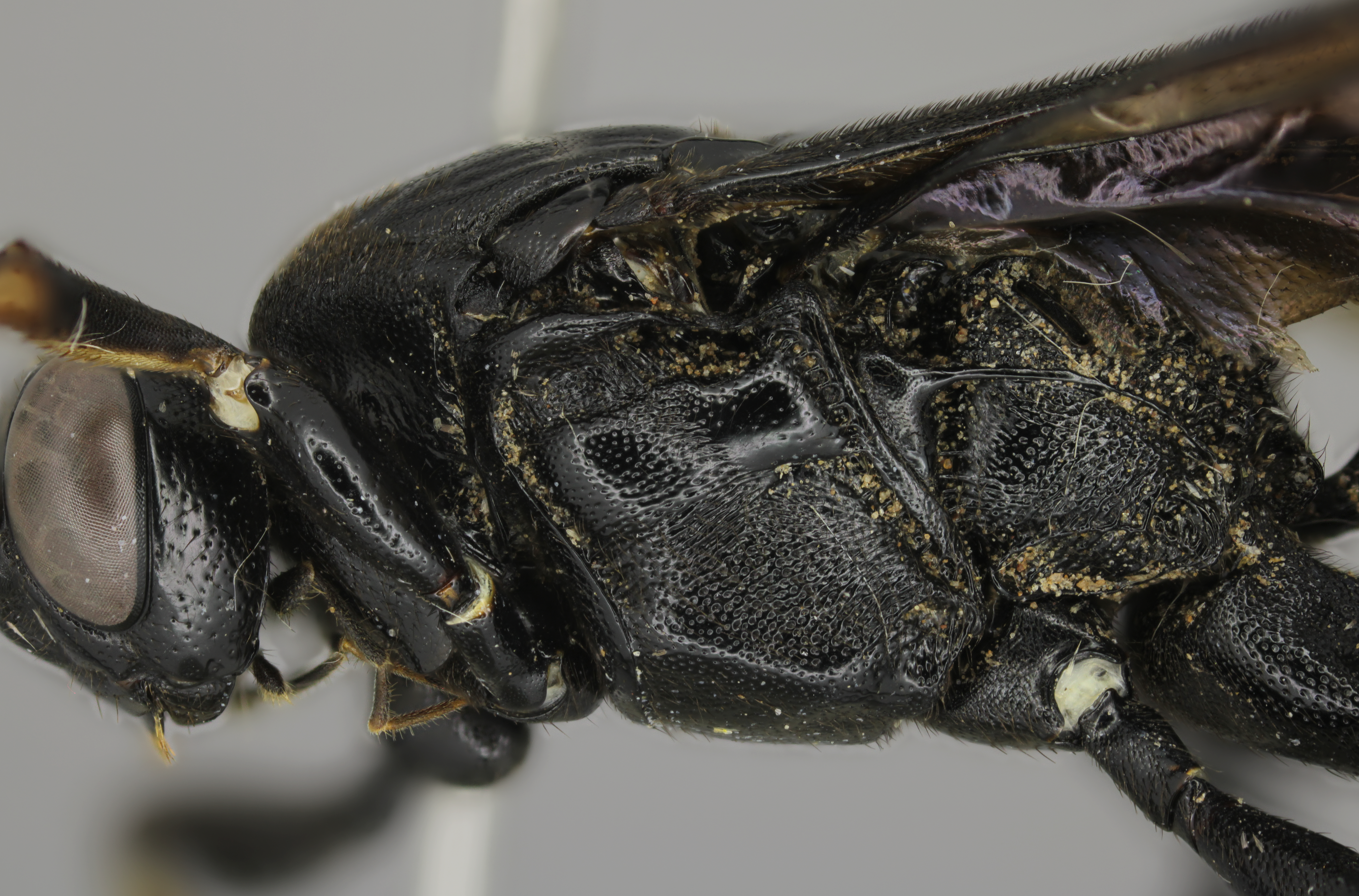
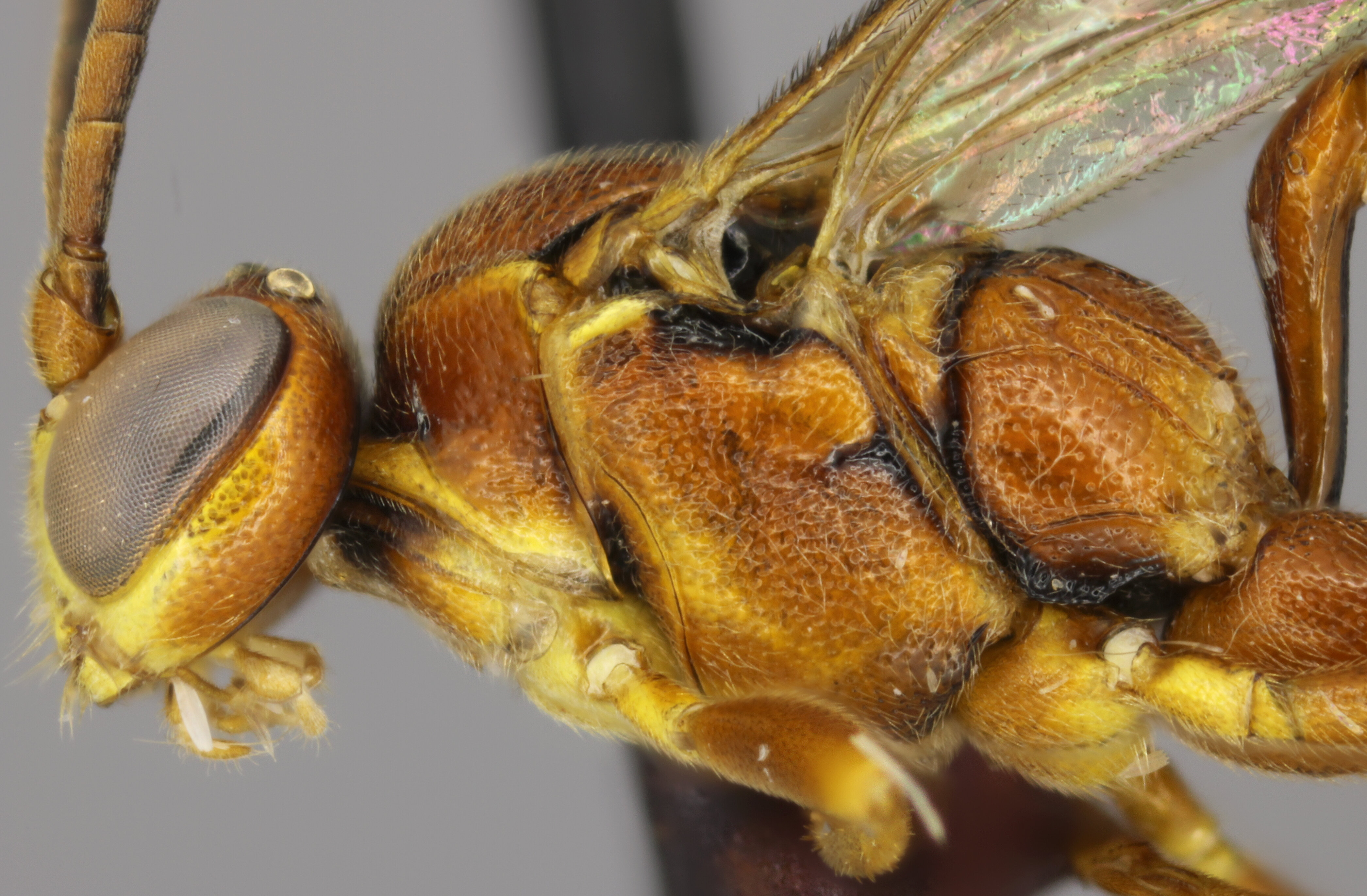
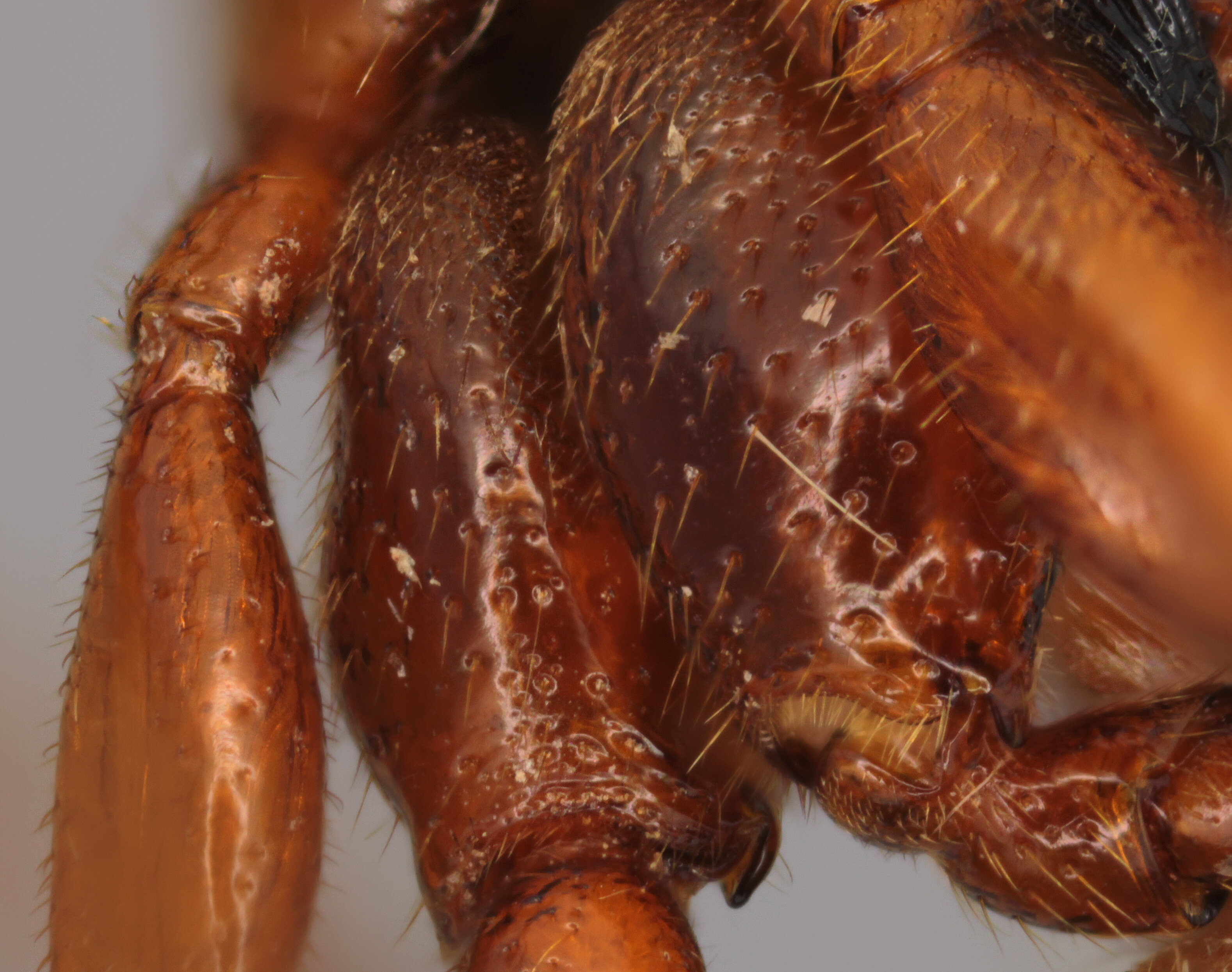
Ichneumoninae is the largest ichneumonid subfamily
with ~4,300 species in 437 genera.
In North America alone, there are around 715 described species,
with likely several hundred more awaiting formal description.
Ichneumonines are among the most striking ichneumonids due to the
striking coloration of many species.
The most commonly encountered species are in the sexually dimorphic
genera like Ichneumon and Diphyus.
Males of these genera are often apparent mimics of stinging wasps
(Aculeata) and can be found
flying above vegetation frenetically searching for
mates. Females tend toward more drab colors like brownish-red and
black and are spend more time searching around vegetation for hosts.
Photo by Doug WechslerPhoto by Denis Doucet
All ichneumonines are endoparasitoids of lepidopterans
and oviposit into the host larva or pupae and almost
always emerge from the
host pupa. The only exception is
Colpognathus which emerges from the mummified remains
of the host final instar larva.
Unlike the many ichneumonid groups
that oviposit into their concealed hosts with the aid of
a long ovipostior, ichneumonine females gain direct access to their
hosts prior to oviposition. This often requires digging
through soil and leaflitter or crawling under bark
crevices and through plant stems.
Species in which the females have a rounded
or blunted metasomal apex (=amblypygous) always attack
larvae and are true koinobionts that oviposit into
earlier instar larvae. Those with a sharper metasimal apex
with an exposed ovipositor (=oxypygous) may either attack
larvae or pupae but probably most commonly oviposit into
prepupal larvae or fresh pupae. Ichneumonines are
somewhat unusual in that many genera overwinter as
adult females in a variety of hibernacula like
tufts of grass, beneath bark, and under moss.
Photo by Julian F.
For published keys, see Gerd Heinrich's series
revising the Ichneumoninae "Stenopneusticae" of the
Northeastern region, which covers all tribes besides
Phaeogenini (=Cyclopneusticae).
Heinrich's keys are critical for identifying most described species.
Although low on figures, the species keys work well and are
normally based on easy-to-view characters like color.
However, some couplets do come down to a
comparison between two species, which is impossible
to evaluate without specimens of both species at hand.
The generic key is somewhat more difficult to use
as it relies on characters that can be difficult to
interpret (e.g., development of the gastrocoelus and
thyridium).
Another confounding factor for beginners with using Heinrich's
generic key is that recently there has been a massive simplification
of ichneumonine tribes (Santos et al. 2021) such that in North America there
are only Ichneumonini, Phaeogenini, and Platylabini.
Acanthojoppini, Listrodromini, Protichneumonini, and Trogini are no longer valid
and have been synonymized with Ichneumonini.
For Florida and other states in the southeastern U.S., see
Heinrich's (1977) "Ichneumoninae of Florida
and neighboring states: (Hymneoptera, Ichneumonidae, subfamily Ichneumoninae)".
This work treats all ichneumonines (including Phaeogenini) in Florida and a
random, partial assortment of those occurring in surrounding states.
It is authoritative for Florida (excluding a few undescribed species),
but by no means for the other southeastern states,
where we know much less.
For a modern and thorough treatment of the Platylabini
of the southeastern U.S.,
see
Dal Pos et al. (2022).
Unfortunately, identifying ichneumonines to species
outside of the eastern U.S. and Canada
is extremely difficult due to a lack of
taxonomic work. This is particularly acute in the western U.S., which
is massively undercollected and where the majority of species
are undescribed.
Head
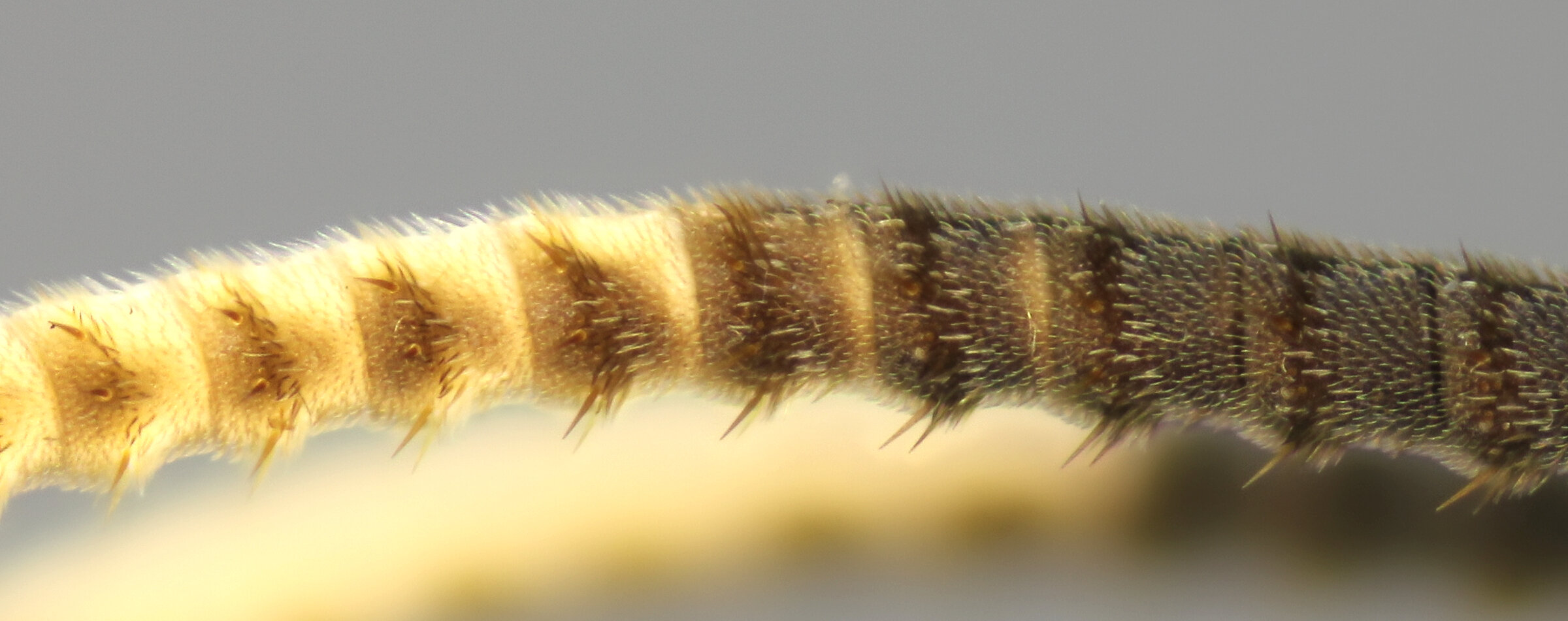
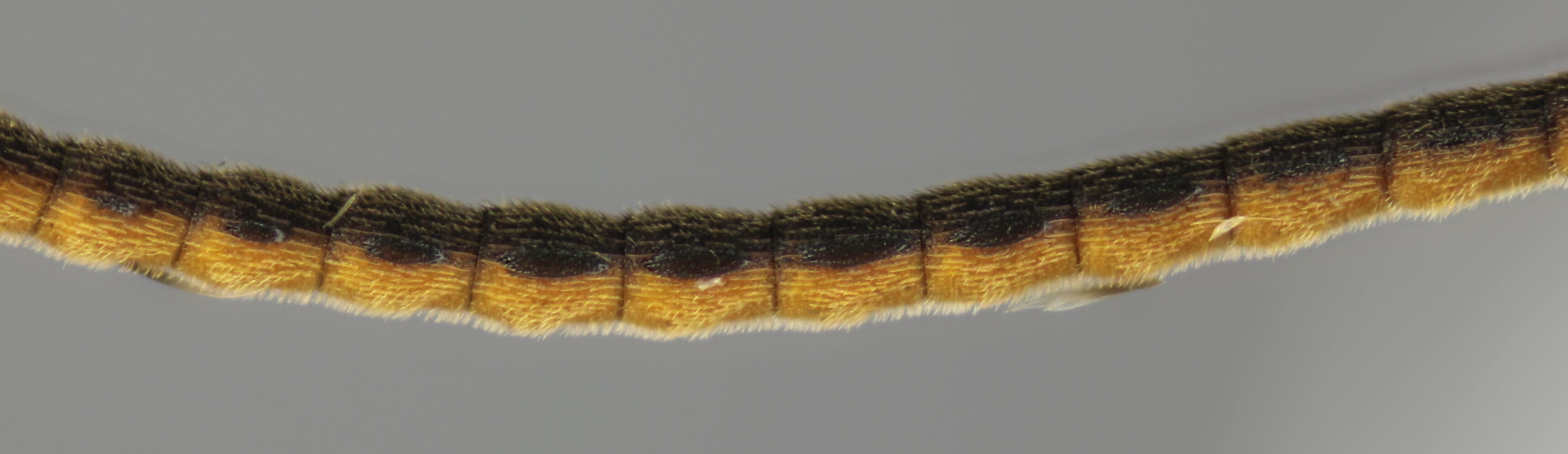
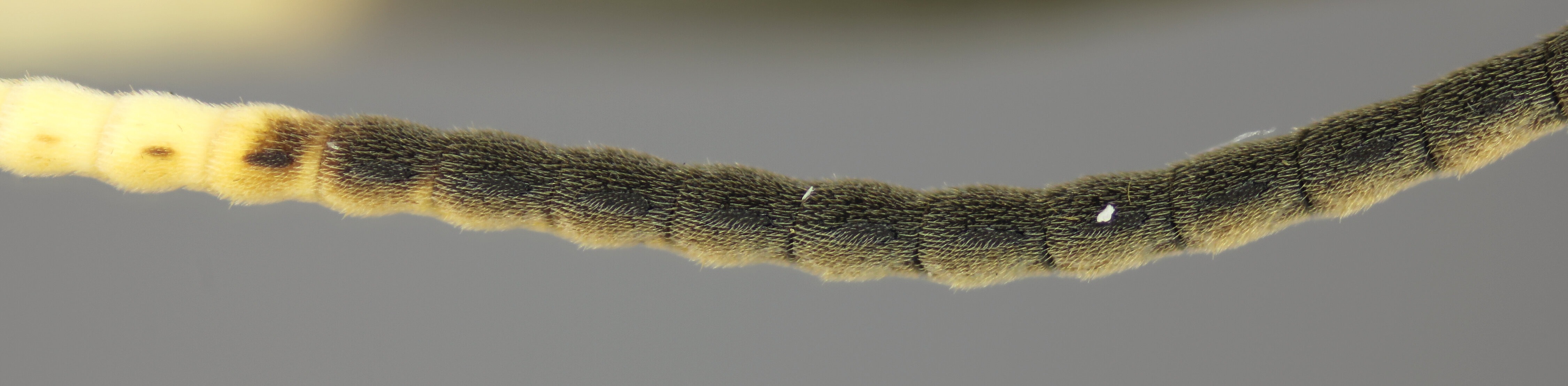
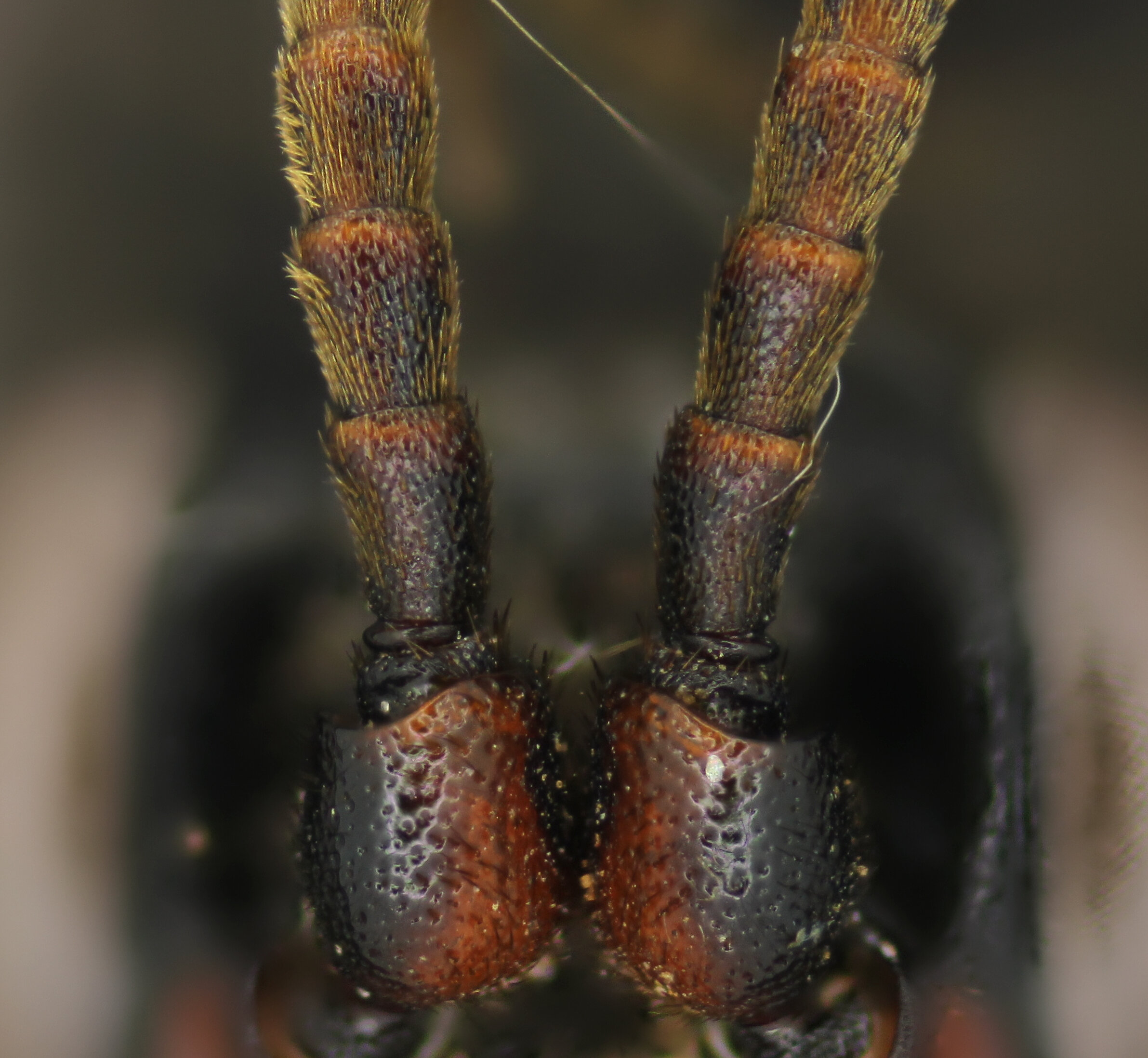
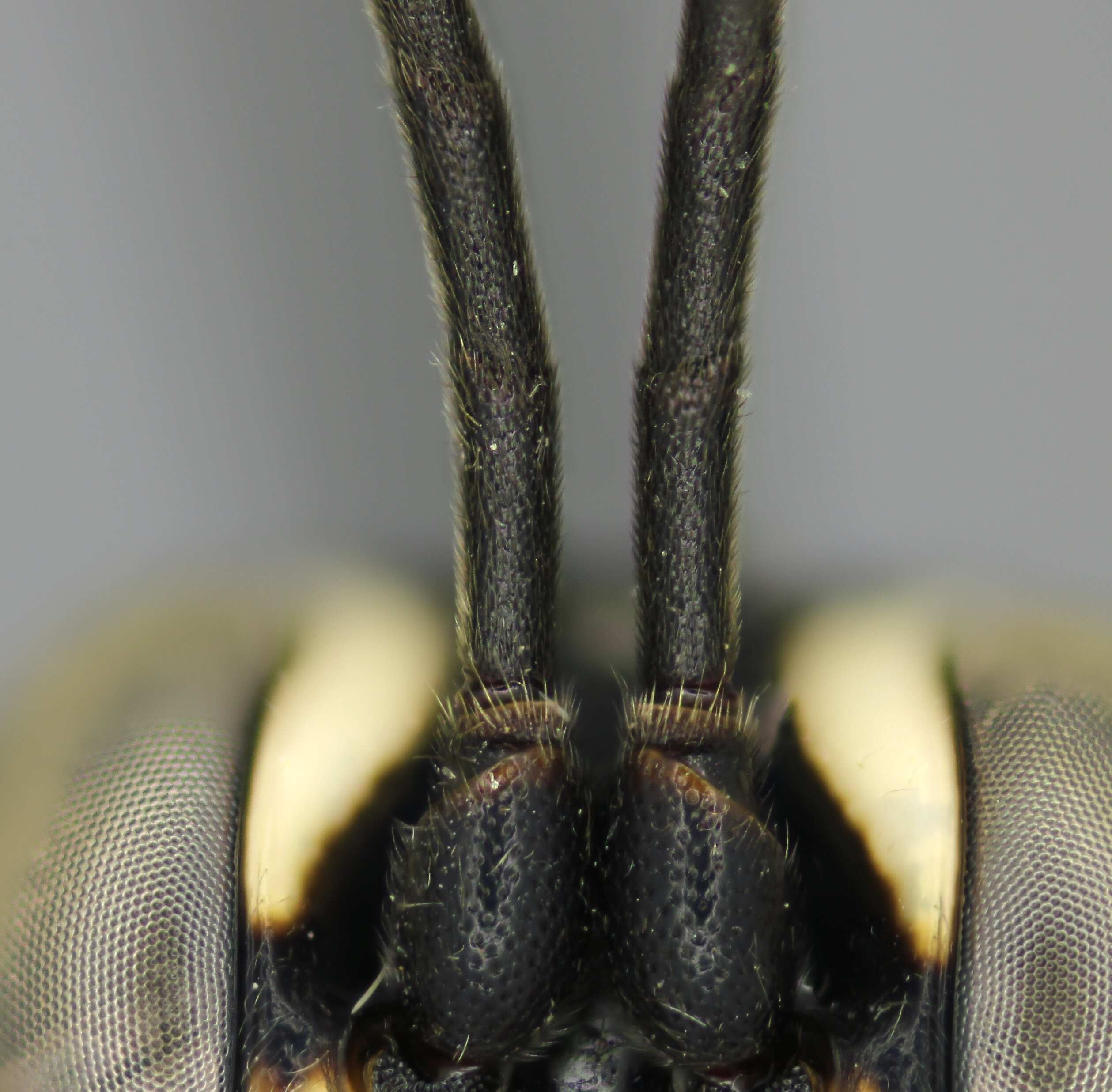
Bristle ridges
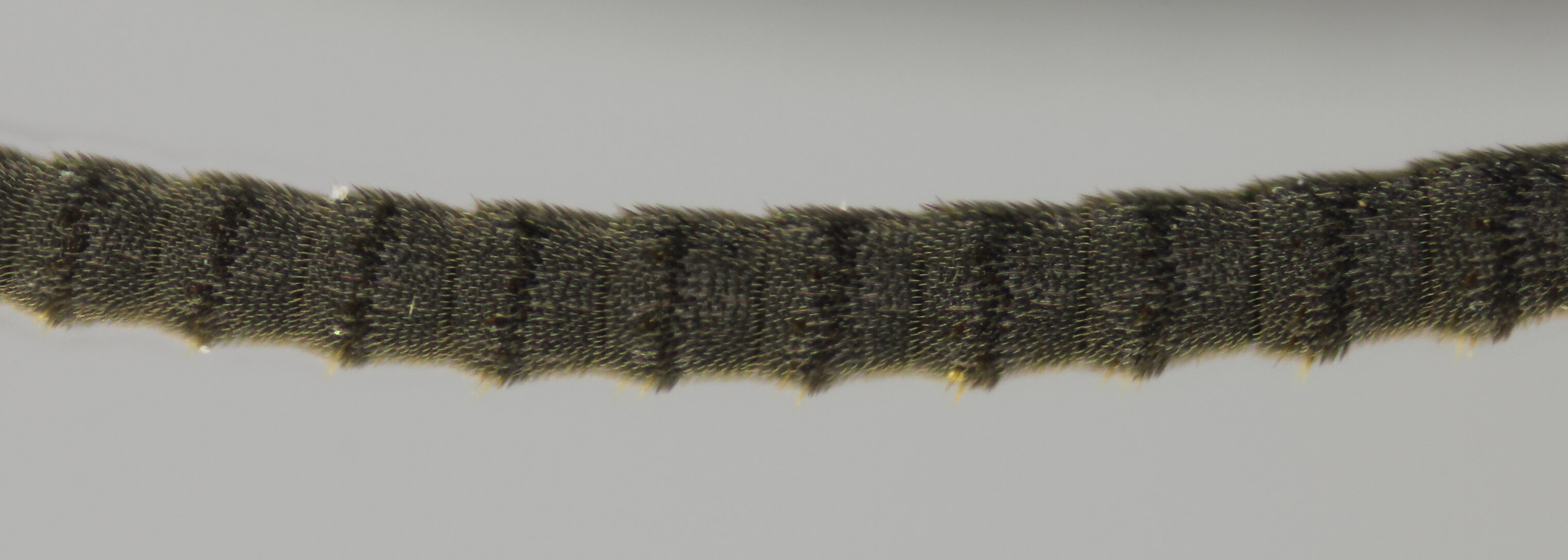
The majority of ichneumonine males have simple filiform antennae where each
individual flagellomere is roughly cylindrical. Bristle ridges are modifications of the
flagellomeres in which nodose transverse ridges are present along the venter of each
flagellomere, complete with a few projecting bristles. The development of bristle
ridges occurs along a continuam. They vary from Cratichneumon and Coelichneumon both have
somewhat weak bristle ridges, in Melanichneumon they are even more
defined. Overall, bristle ridges are less common in
temperate taxa than in tropical ones but strongly developed bristle ridges can be seen
in Carinodes, Plagiotrypes, Setanta, Tricholabus,
and Trogomorpha, which occur in the Nearctic and Neotropics.
no image yet
Absent
No trace of bristle ridges.
no image yet
Weak
Bristle ridges are
visible but not particularly acute or
prominent.
no image yet
Moderately developed
Bristle ridges intermediate between
weak and strong
Strong
Bristle ridges strongly nodose.
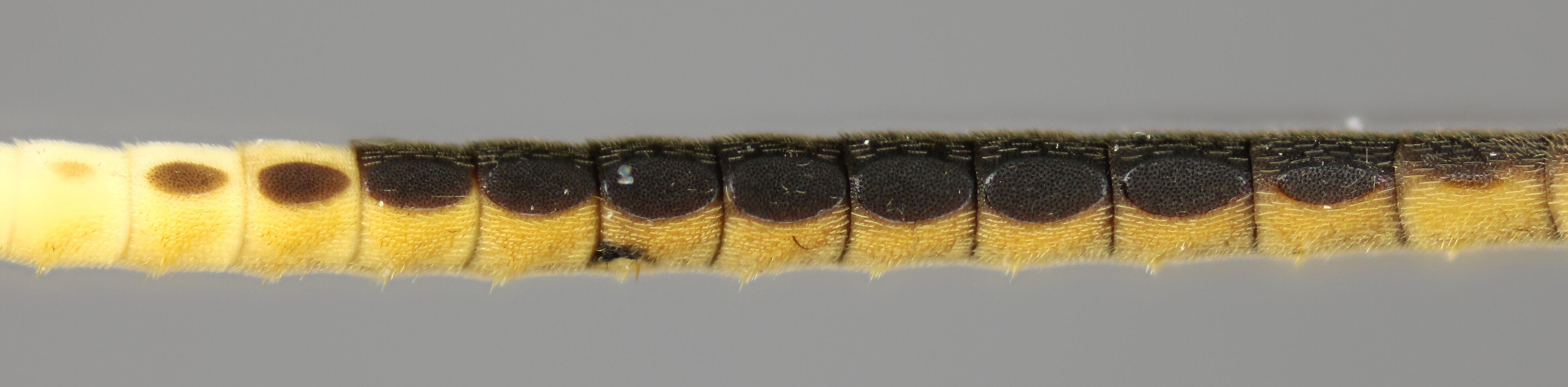
Tyloids
Tyloids are raised areas on the dorsolateral surface of the male flagellomeres.
The size and shape of the tyloids vary considerably as well as which
flagellomeres they span. Regarding size, tyloids vary from
being minute, barely visible dots to occupying the entire length and width of the
dorsolateral surface of the flagellomere. The shape varies along with their size,
but is typically characterized as being either bacilliform (rod-like), linear, or ovoid.
The majority of male ichneumonines posess tyloids but some do not. Both the presence/ absence
and which flagellomere the tyloids begin on are important generic characters.
More broadly, the morphology of tyloids is typicall species specific and can be critical in
separating males of otherwise similar species.
no image yet
Absent
Medium-sized
Enlarged
Female flagellum
*****
no image yet
Filiform
***.
no image yet
Bristle-shaped
***.
Female basal flagellomeres
*****
Basal flagellomeres stout
First flagellomere less than 1.5x as wide as long.
no image yet
Basal flagellomeres moderate length
***.
Basal flagellomeres elongate
Greater than 3 times
as wide as long.
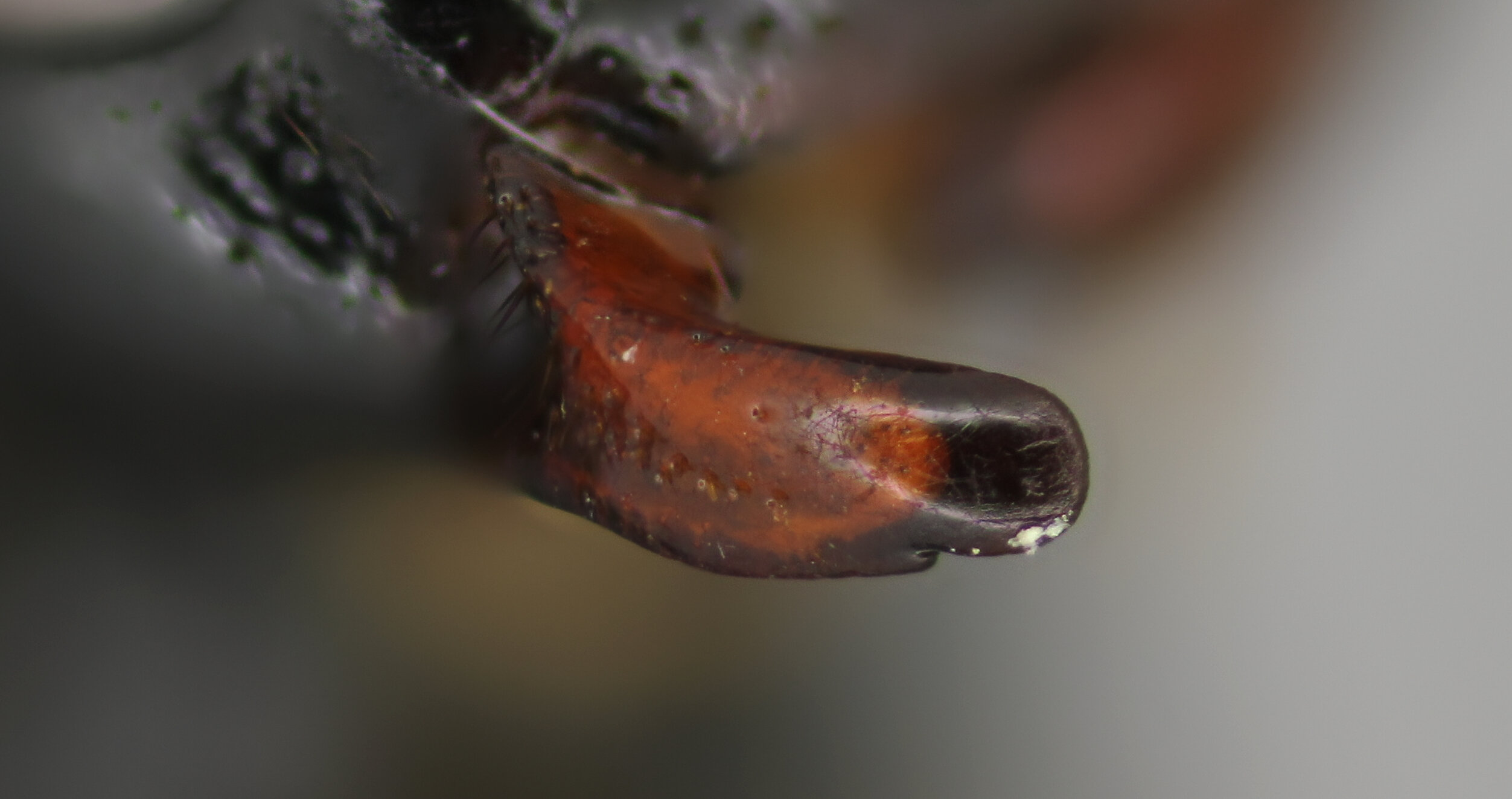
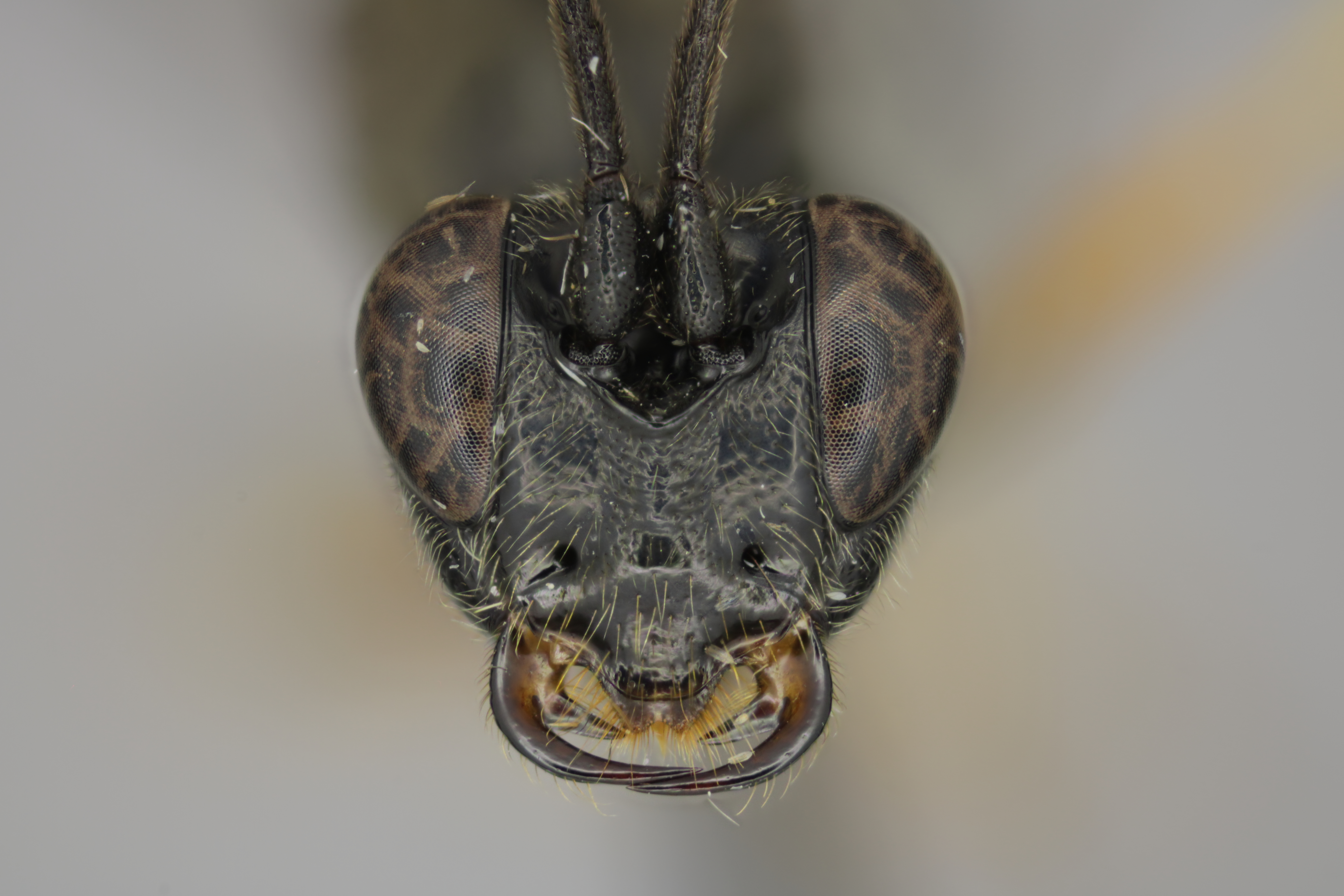
Mandible
The mandible in ichneumonines is typically bidentate and moderately
narrow with the dorsal tooth slightly longer than the ventral tooth,
but there are several significant modifications as described in
each section.
no image yet
Bidentate, moderately narrow
no image yet
Bidentate, wide, with subequal teeth
The bidentate mandible
with subequal teeth (i.e., the dorsal and ventral teeth are equal in
length or nearly so) is seen in Trogomorpha, Anisobase,
Neotypus, and some Tricholabus.
Unidentate, shovel-shaped
The unidentate, shovel-shaped mandible is seen
mainly in Obtusodonta females. This is somewhat unusual in that
most ichneumonines with unidentate mandibles normally have narrowed mandibles,
while in Obtusodonta the mandible is fairly wide throughout and the
ventral tooth is somewhat present but only reduced to a small notch along
the ventral margin.
Bidentate, sickle-shaped
The now synonymized Joppocryptini (sunk under Ichneumonini) was largely
characterized by the sickle-shaped (=falcate) mandible in which it is narrowed
and curved along its length. This comes in several forms from bidentate as
seen here in Joppocryptus to unidentate Plagiotrypes to
even tridentate (with accessory basal tooth) as seen in Lobaegis.
Mesosoma
Juxtacoxal carina
The juxtacoxal carina is arched carina on the ventral division of
metapleuron. It is present in most Ichneumoninae but occasionally
entirely absent. There are also a very common intermediate state where
the carina is partially obscured by rugae/rugulae. Often times, the
intermediate state is not differentiated from present, except in
extreme cases.
Absent
No trace of the carina on the ventral
division of the metapleuron.
Partially obscured by rugulae
The carina is
traceable but broken up or overrun by the sculpture of the metapleuron.
Present
The carina complete and unobscured,
arching across the ventral division of the metapleuron.
Scutellar carinae
The lateral margins of the scutellum may be simple and evenly rounded, or bordered by a
raised lateral carina. When present, the carina may run
the full length of the scutellum or fade out apically
The development of lateral scutellar carinae is
generally constant within a genus and is used at several points generic keys.
Scutellum without lateral carina
The sides of the scutellum grade evenly
into the surrounding surface, with no raised ridge along the lateral margin.
Scutellum laterally carinate
A distinct raised carina borders the lateral
margin of the scutellum, delimiting the disc from the lateral slope.
Propodeal apophyses
The propodeal apophyses are the paired projections borne at the lateral ends of the
posterior transverse carina of the propodeum, above the hind coxae. They range from entirely
absent, through short blunt teeth and thin flanges, to long acute spines. Judge them in lateral
view, where the length of the projection can be compared against its basal width. The state is often
constant within a genus and is used at several points in the generic key, though the
distinction between tooth-like and spine-like grades continuously and some genera span both.
Absent
The posterior transverse carina ends without a projection, the
lateral margin of the propodeum evenly rounded.
Lamellate
The projection flattened into a thin plate or flange, broader
than it is thick and not narrowed to a point.
Tooth-like
A short, broad-based projection, no longer than wide at its
base and usually blunt at the tip.
Spine-like
A long, acute projection, distinctly longer than wide at its
base and tapering to a point.
Areola
The areola is the enclosed median area on the dorsal face of the propodeum, bounded
by the lateral longitudinal carinae and by the anterior and posterior transverse carinae. In
most Ichneumoninae it is a well-defined cell whose outline – hexagonal, pentagonal,
heart-shaped, or elongate – carries generic information. In some genera the bounding
carinae are lost and the areola is represented only by a small raised, shining swelling.
Assess it in dorsal view, with the propodeum level.
Carinate
The areola completely enclosed by distinct carinae, its outline
traceable all the way around.
Reduced to a small polished boss
The bounding carinae effaced, the areola
indicated only by a small, smooth, shining swelling on the propodeal dorsum.
Second lateral area of the propodeum
The second lateral area is the field of the propodeum lying immediately lateral to
the areola, bounded medially by the lateral longitudinal carina, laterally by the pleural
carina, and fore and aft by the two transverse carinae. Its proportions are compared against
the areola alongside it: in most genera the two run roughly level with one another, but in a
few the second lateral area is drawn out well behind the areola. Judge it in dorsal or
dorsolateral view, with both areas visible at once. The separation between the normal and
long second lateral areas is perhaps the most confusing couplet in the Heinrich (1960)
generic key. While hard to judge, it also helps to consider it along with other diagnostic
characters for Coelichneumon and Protichneumon which have an elongated
second lateral area.
Normal
The second lateral area about as long as the areola, its posterior
margin not extending appreciably beyond it.
Elongated
The second lateral area distinctly longer than the areola,
extending well behind it. This is really only characteristic of Coelichneumon
and Protichneumon.
Wings
Areolet
The areolet is the small cell toward the apex of
the forewing immediately apical to the
horse head-shaped cell. In the vast majority
of ichneumonines, it is pentagonal. However, several
other variations also occur.
no image yet
Pentagonal
Veins 2rs-m and 3rs-m converge anteriorly but do not meet, so a short
section of Rs forms a fifth side. The usual state in Ichneumoninae.
no image yet
Four-sided
Veins 2rs-m and 3rs-m meet at a single point on Rs, so the areolet is
rhombic or diamond-shaped.
no image yet
Open apically
Vein 3rs-m is absent, so the areolet is not closed on its apical side.
Legs
Coxal modifications
There are two types of modifications of the female hind coxa: a scopa
And various types of projections that vary from being dentate, lobe-like, and carinate.
These modifications are apparently used as aids in oviposition but the specifics are not
entirely clear. A scopa is a dense patch of setae.
Only some female Ichneumonini possess a
scopa. In exceptional cases, a scopa may also be present on the mid coxa. The coxal
projections are unique to Phaeogenini (except for Stenichneumon culpator, at least
in the Nearctic). Within genera, the presence or absence of a
scopa or projection can be variable but the size and shape of a modification
can be an important species-specific character.
Scopa absent
No apparent trace of a scopa.
Scopa small
Scopa present but occupying a small portion of the
hind coxa.
Scopa medium-sized
Scopa intermediate in size.
no image yet
Scopa large
Scopa occupying a majority of the hind coxa venter. In some species,
the large scopa is paired with a smaller scopa on the mid coxa.
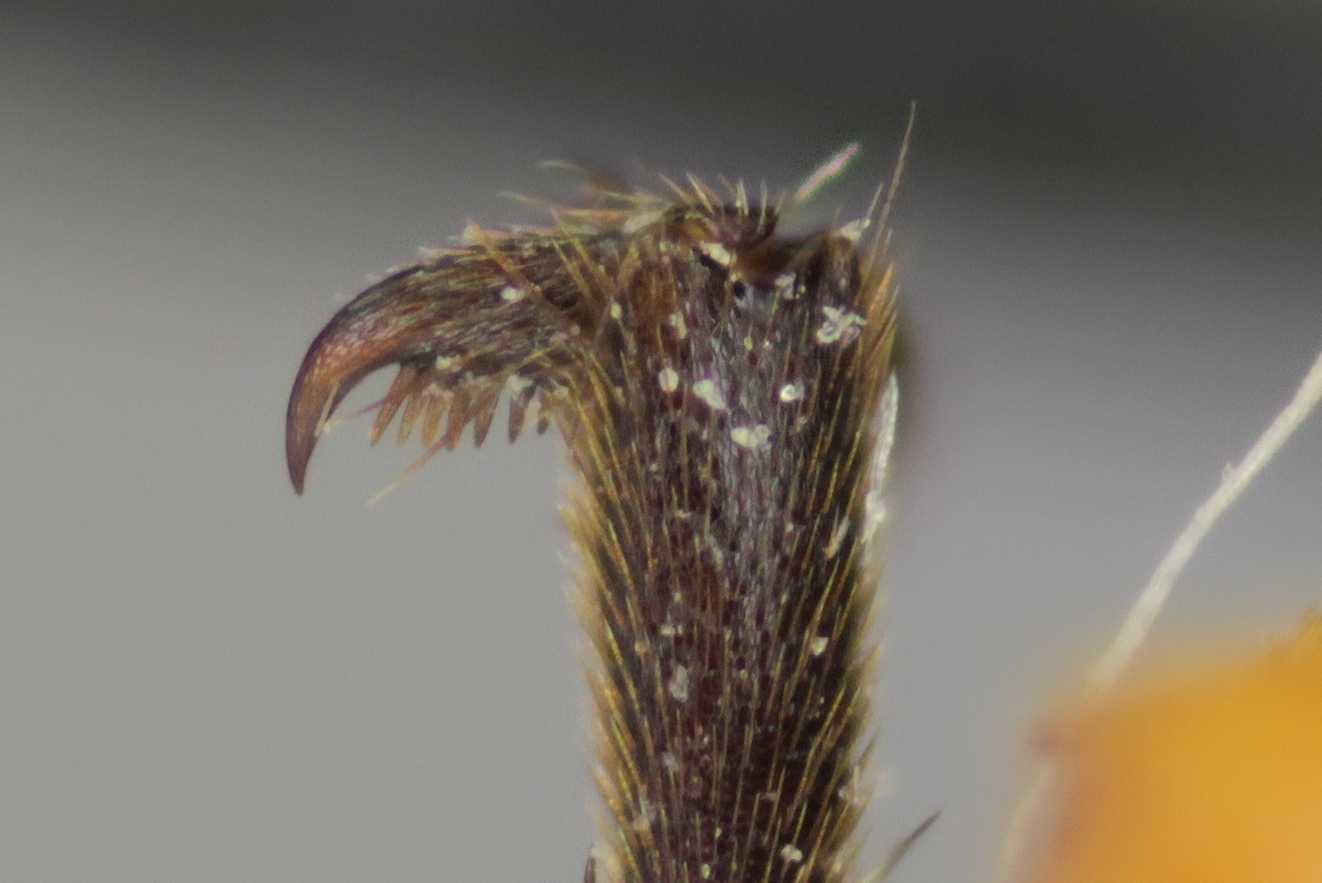
Tarsal claw
The tarsal claws are the paired hooks at the apex of the fifth tarsomere.
In most ichneumonines they are simple, meaning the inner margin is
smooth apart from a basal lobe. In a few taxa the inner margin carries a
comb-like row of slender teeth, or pectinae, and the claw is then described as
pectinate. The character is best examined on the hind leg at high
magnification, with the claw viewed in profile against a pale background.
Pectinate claws are rare in the Nearctic fauna.
no image yet
Simple
Inner margin of the claw without teeth, at most with a
basal lobe.
Pectinate
Inner margin of the claw with a comb-like row of
slender teeth.
Metasoma
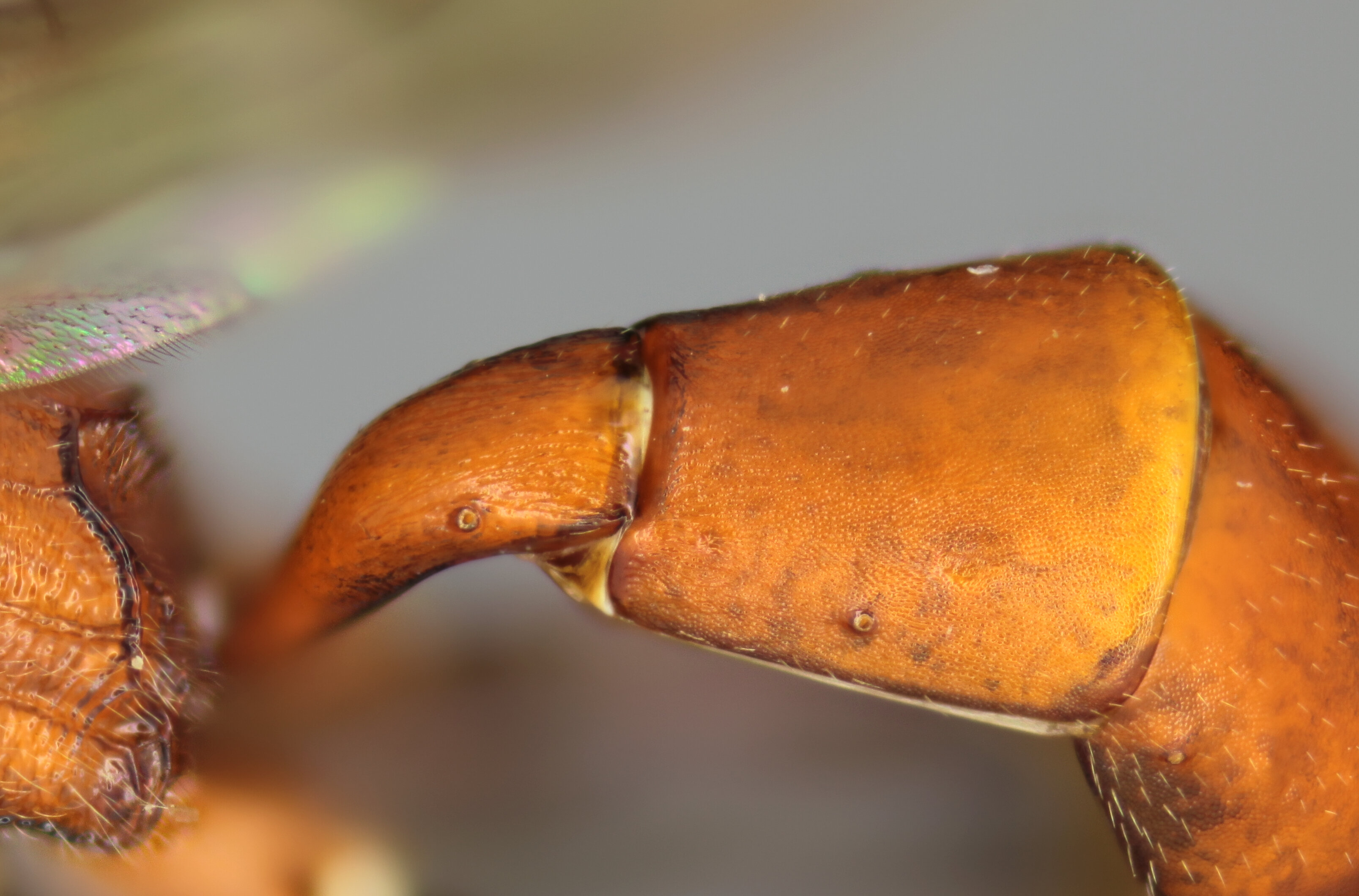
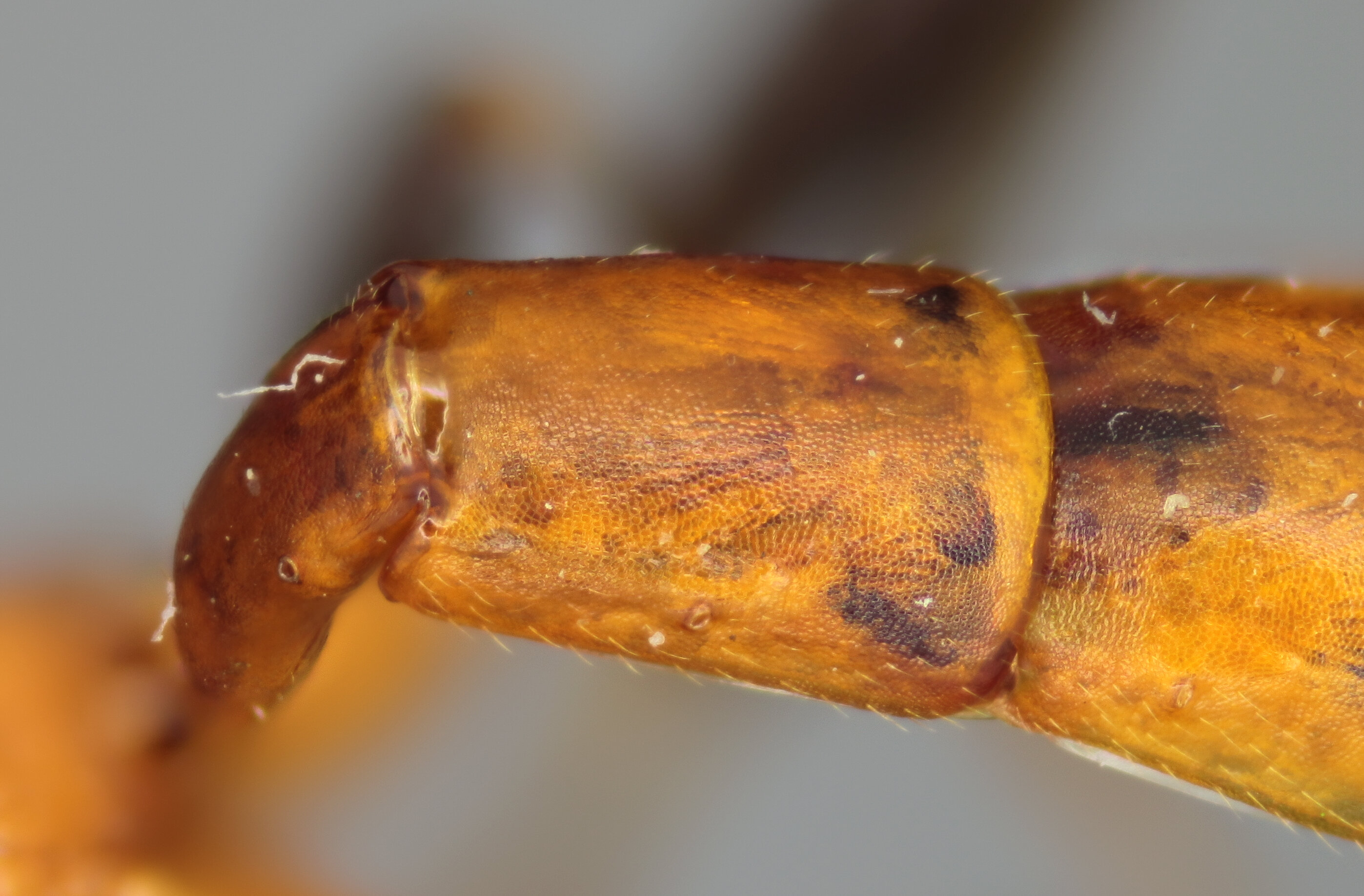
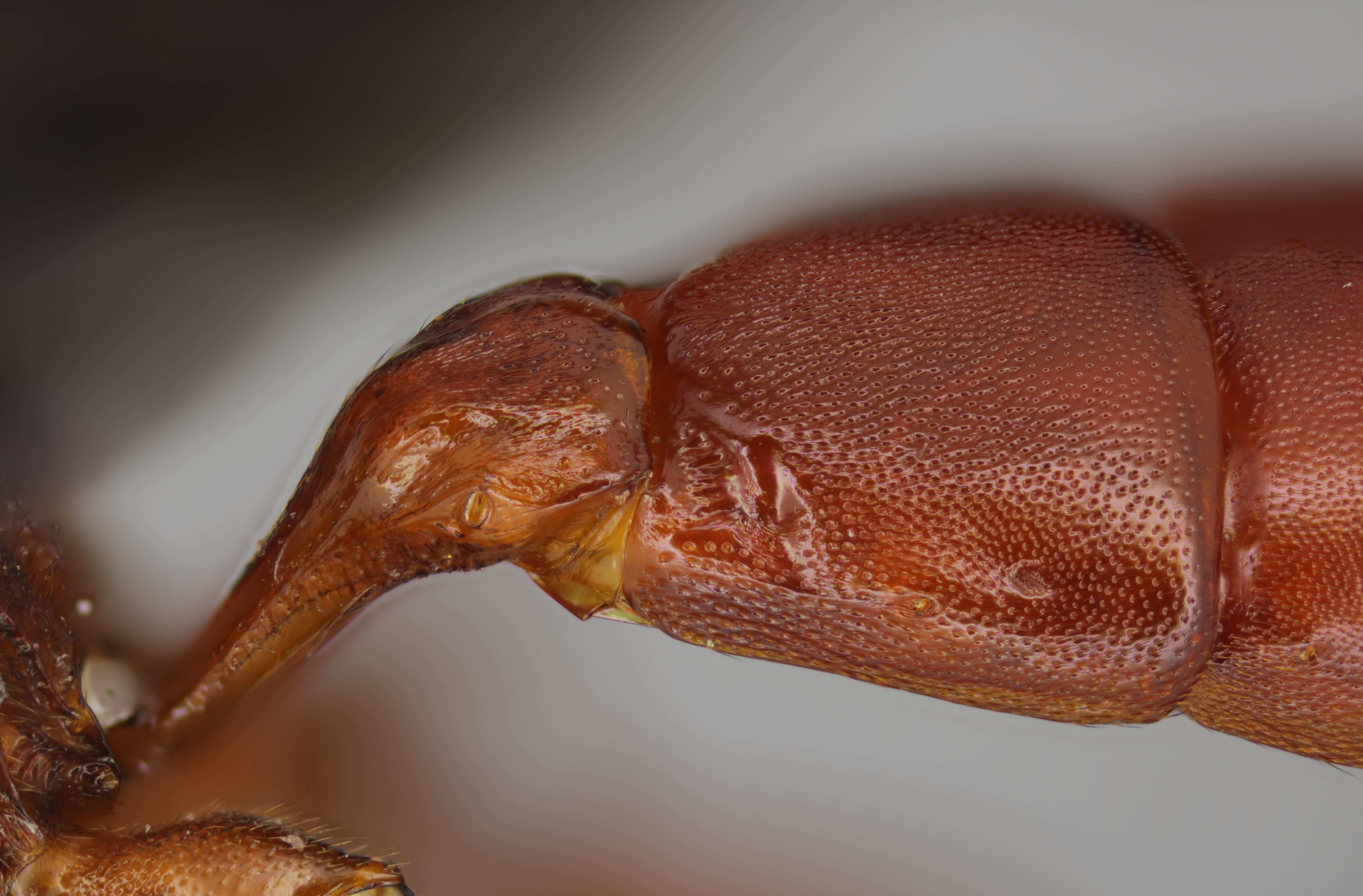
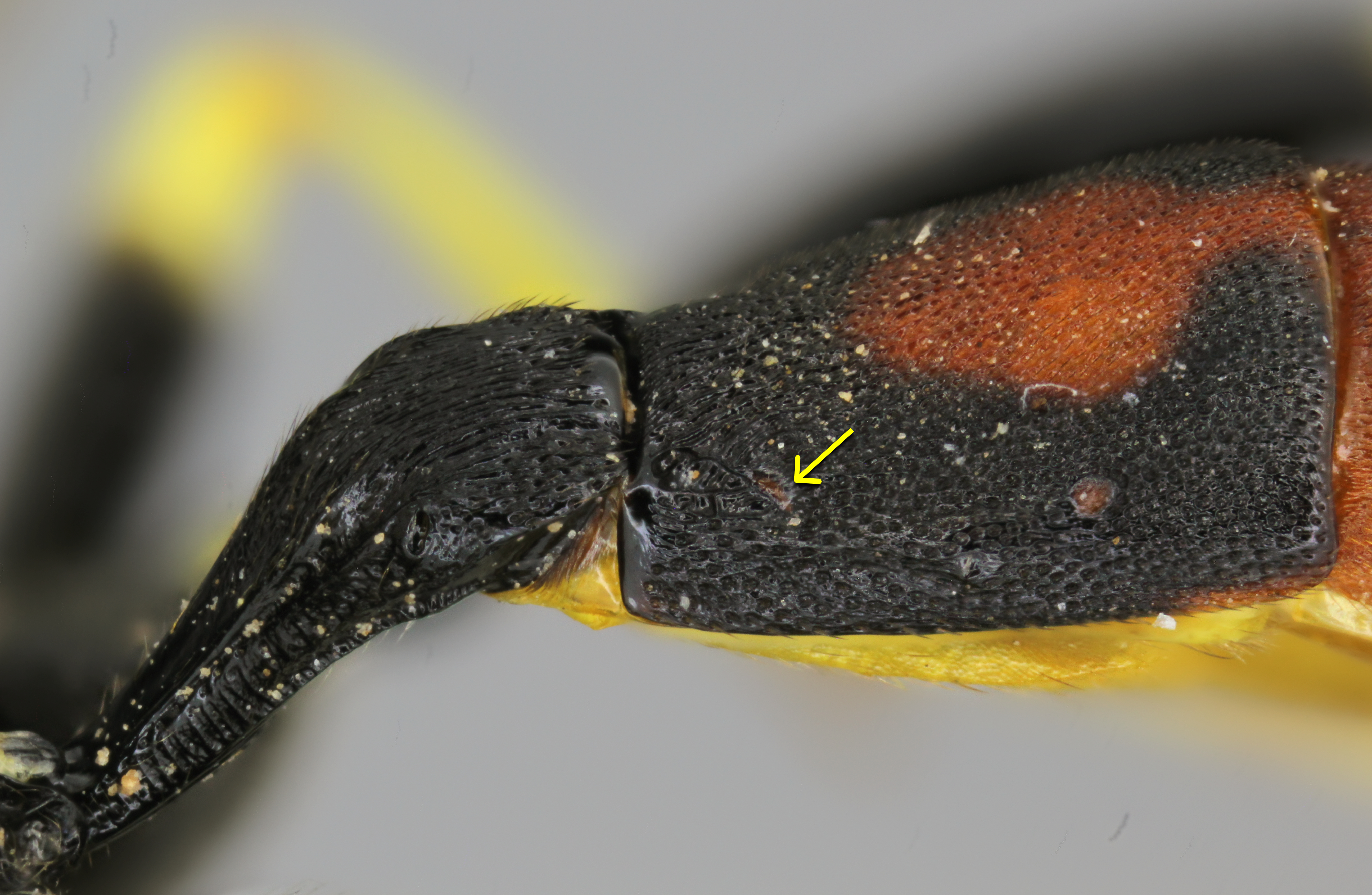
Postpetiole surface sculpture
The surface sculpture of the postpetiole (the wider, posterior section of the
first metasomal tergite) is a major character that separates genera and even larger
genus-groups. The three primarily states are smooth/granulate, densely punctate, and
striate, though intermediates between these states occur.
Smooth
Postpetiole primarily free of punctation, striation, or rugosity. Sometimes
with a few punctures laterally. Often, taxonomists group a smooth and granulate postpetiole
together.
Densely punctate
Distinct punctures covering most of the postpetiole
of the first metasomal segment.
no image yet
Longitudinally striate
Linear striations ....
no image yet
Rugulose
****
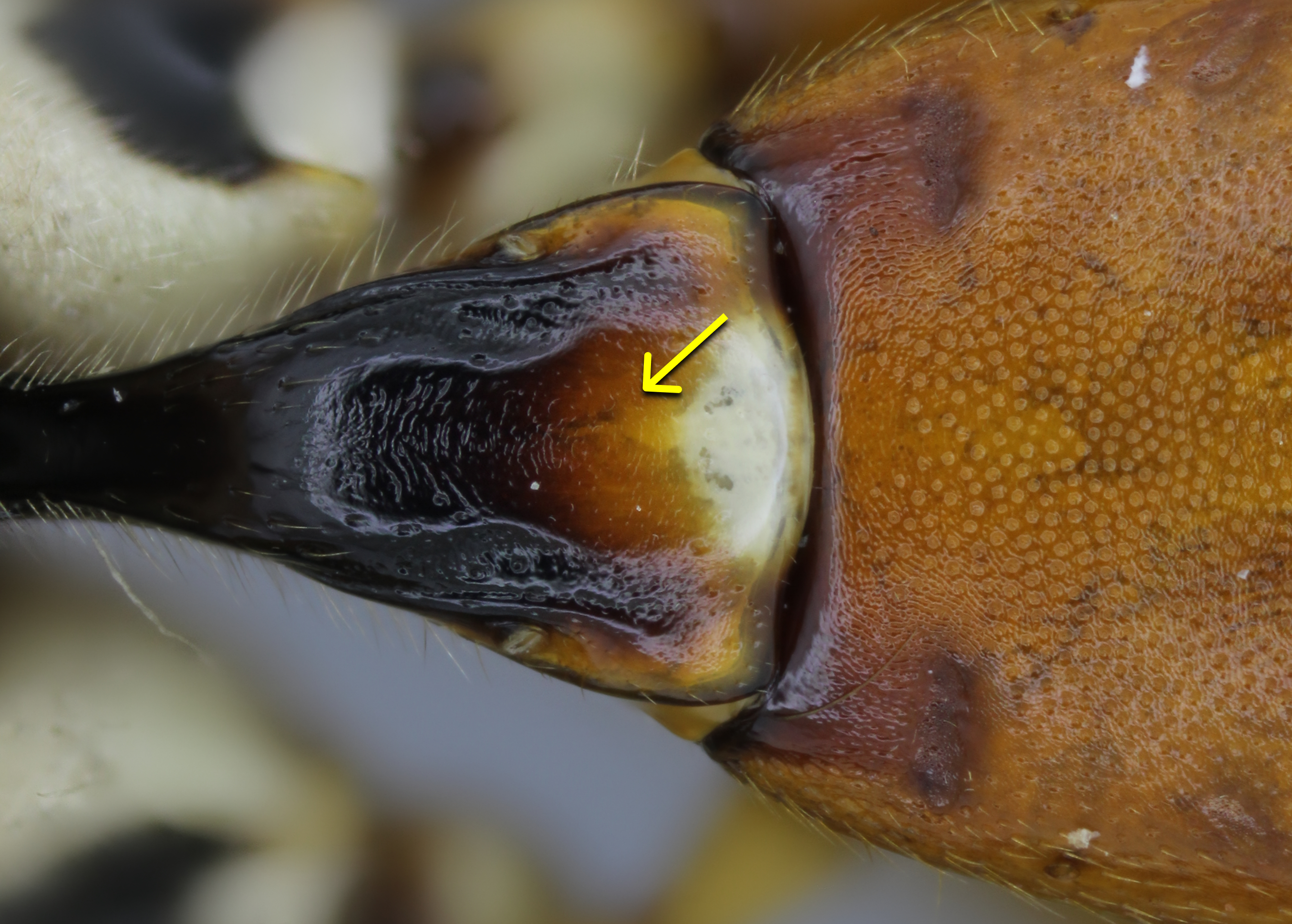
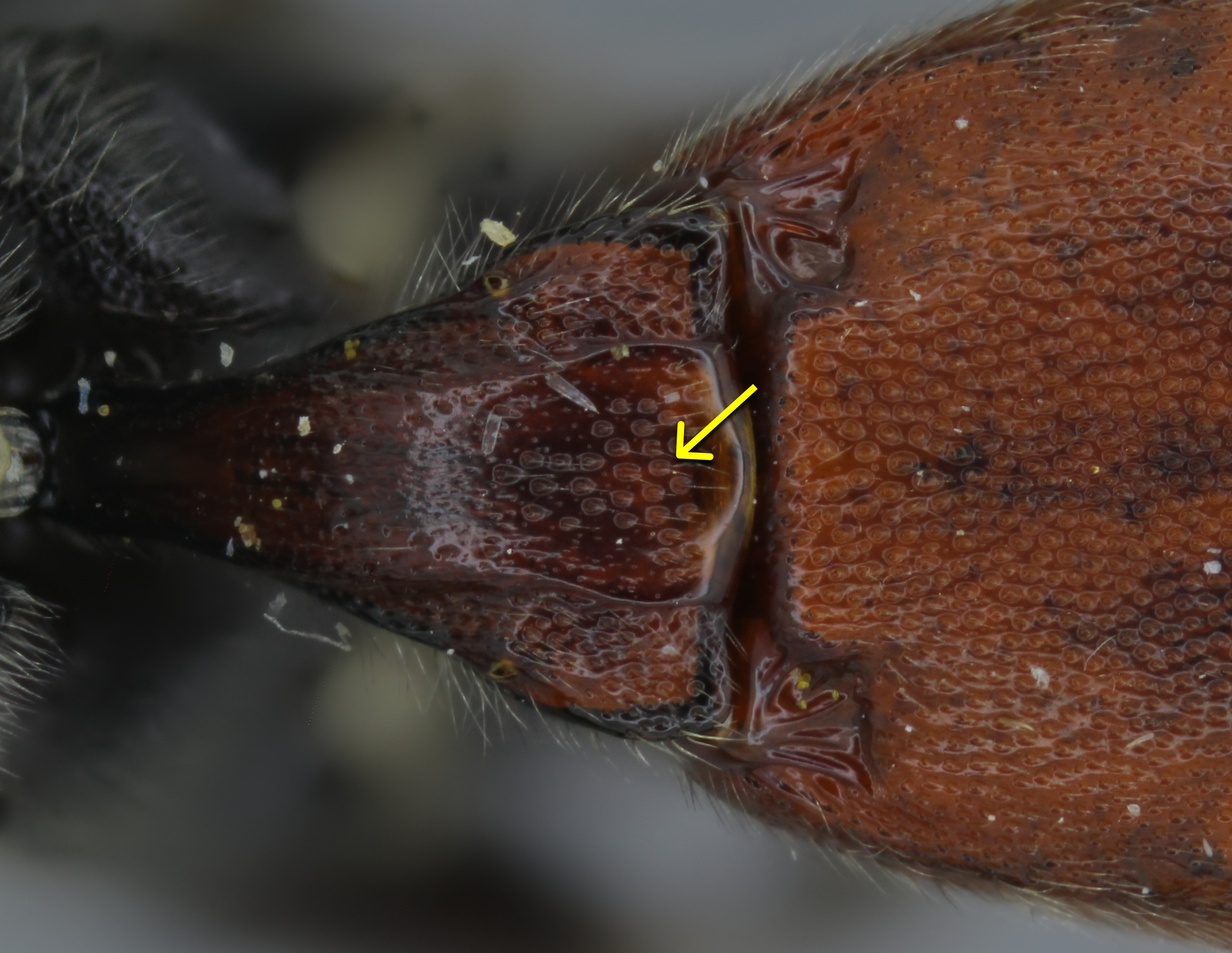
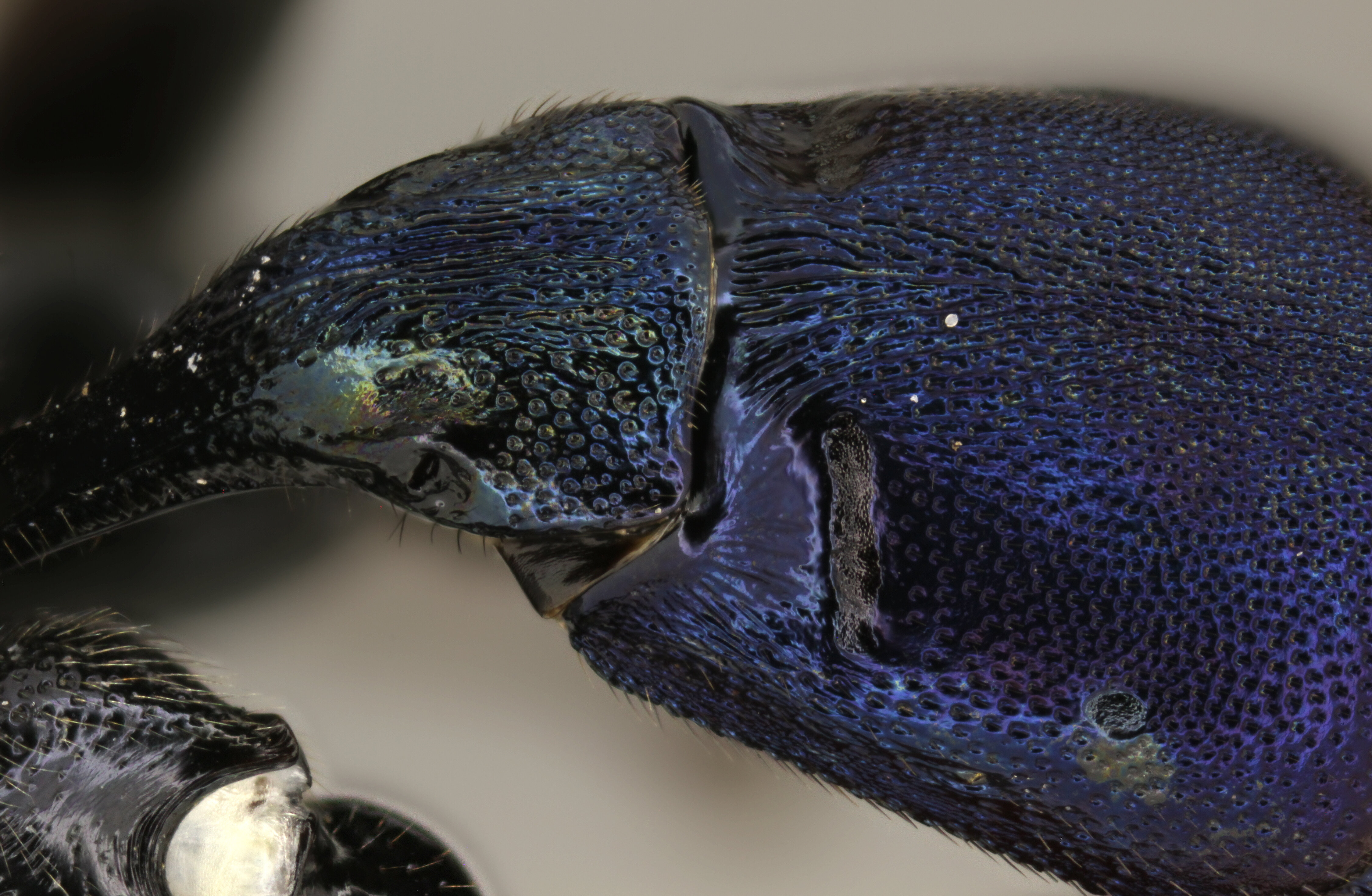
Thyridium
The thyridium is a matt area on the anterior of the second metasomal tergite. It should not
be confused with the pseudothyridium on the posterior half of the second metasomal tergite. The
thyridium varies from minute as in Diphyus to nearly spanning the entire width of the
tergite as in Stenichneumon. The width is usually discussed in relation to the
interthyridial width meaning the interval between both thyridia.
The size of the thyridium is usually shared among all members of a genus though there are
exceptions like in Ichneumon where it varies from narrower than the interthyridial
width to considerably wider than it. Measure the thyridium at its widest point, in dorsal
view with the tergite level, and compare that width against the interval between the two
thyridia rather than against the width of the tergite.
Absent
There is no trace of the thyridium. The gastrocoelus is normally absent as well.
Ctenichneumon (last image) is the exception: the thyridium is absent but
the gastrocoelus is deeply impressed. Its smooth area can look like a thyridium
but lacks the matt texture.
Small
Thyridium present but small and scar-like.
Well developed, narrower than the interthyridial width
Thyridium
a clearly defined matt area, but its width less than the interval separating the two
thyridia.
Gastrocoelus
*****
Absent
No depression visible on anterior of
second metasomal tergite. This is normally associated with an entirely
absent thyridium as well.
Shallow
Gastrocoelus present but only as a small shallow depression.
no image yet
Moderately impressed
****.
Deeply impressed
The gastrocoelus is deeply impressed. Normally, this is associated with a
moderately wide or at least well-defined thyridium, but is infrequently present even in
genera that lack a thyridium (mainly Ctenichneumon).
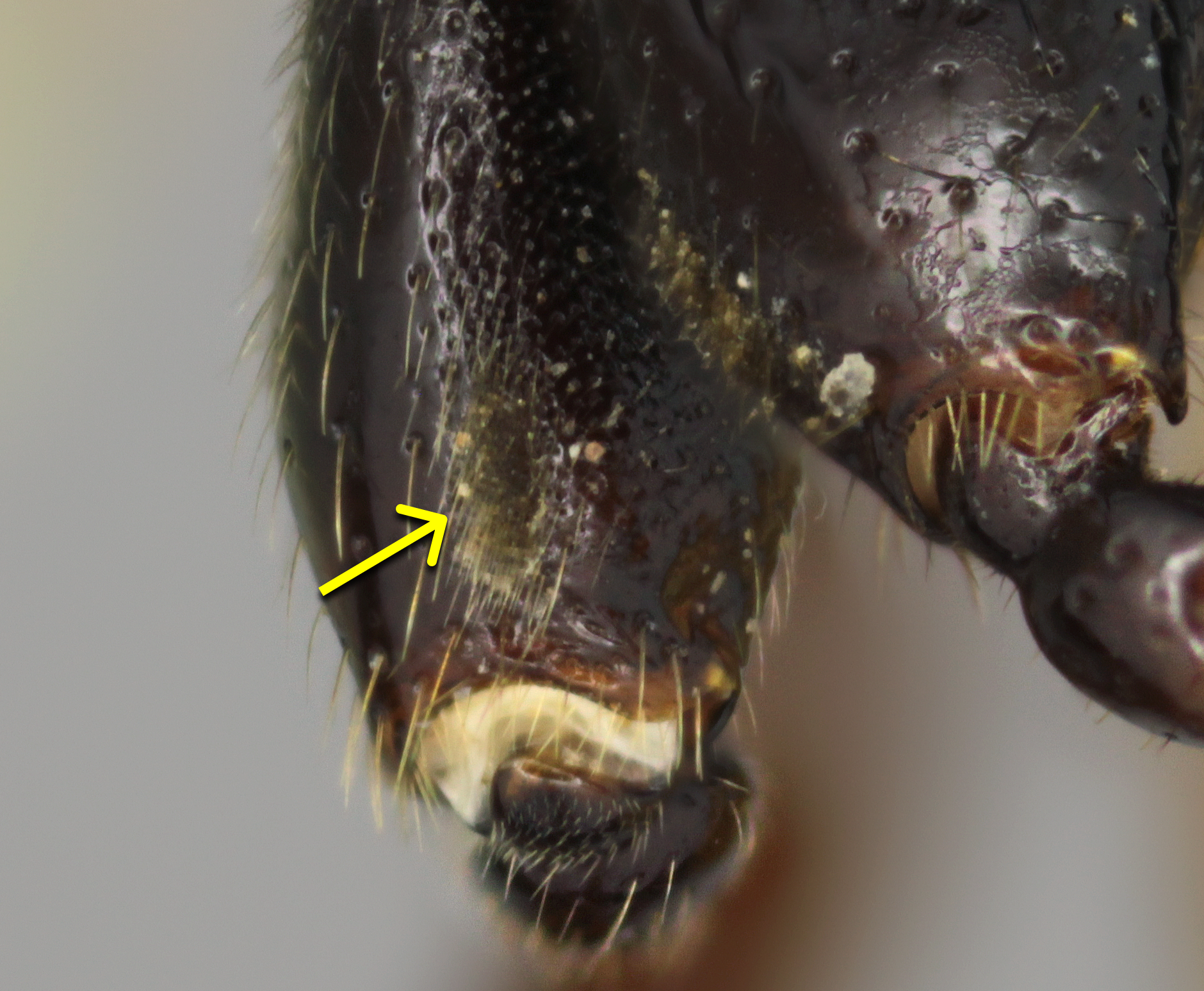
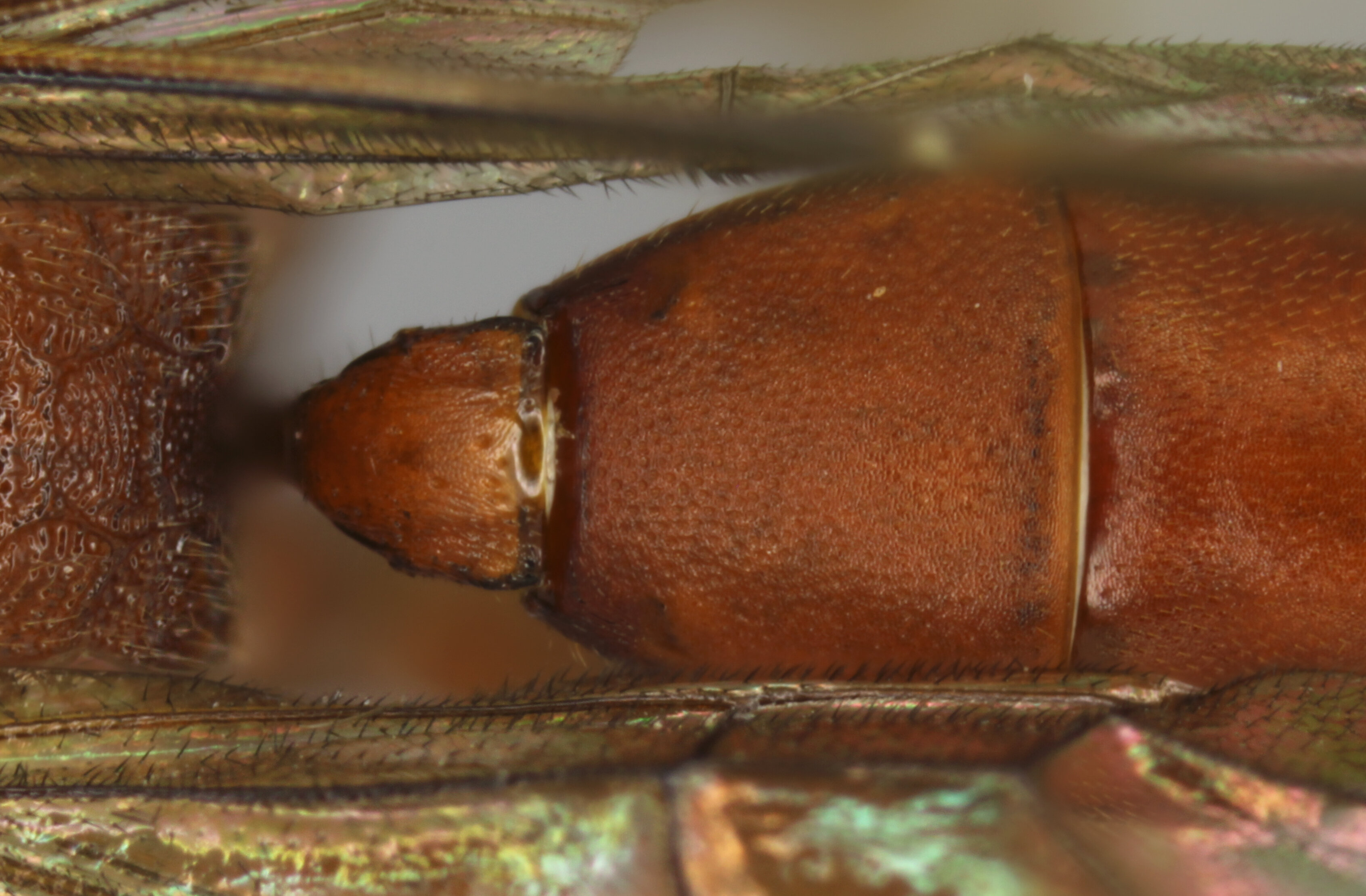
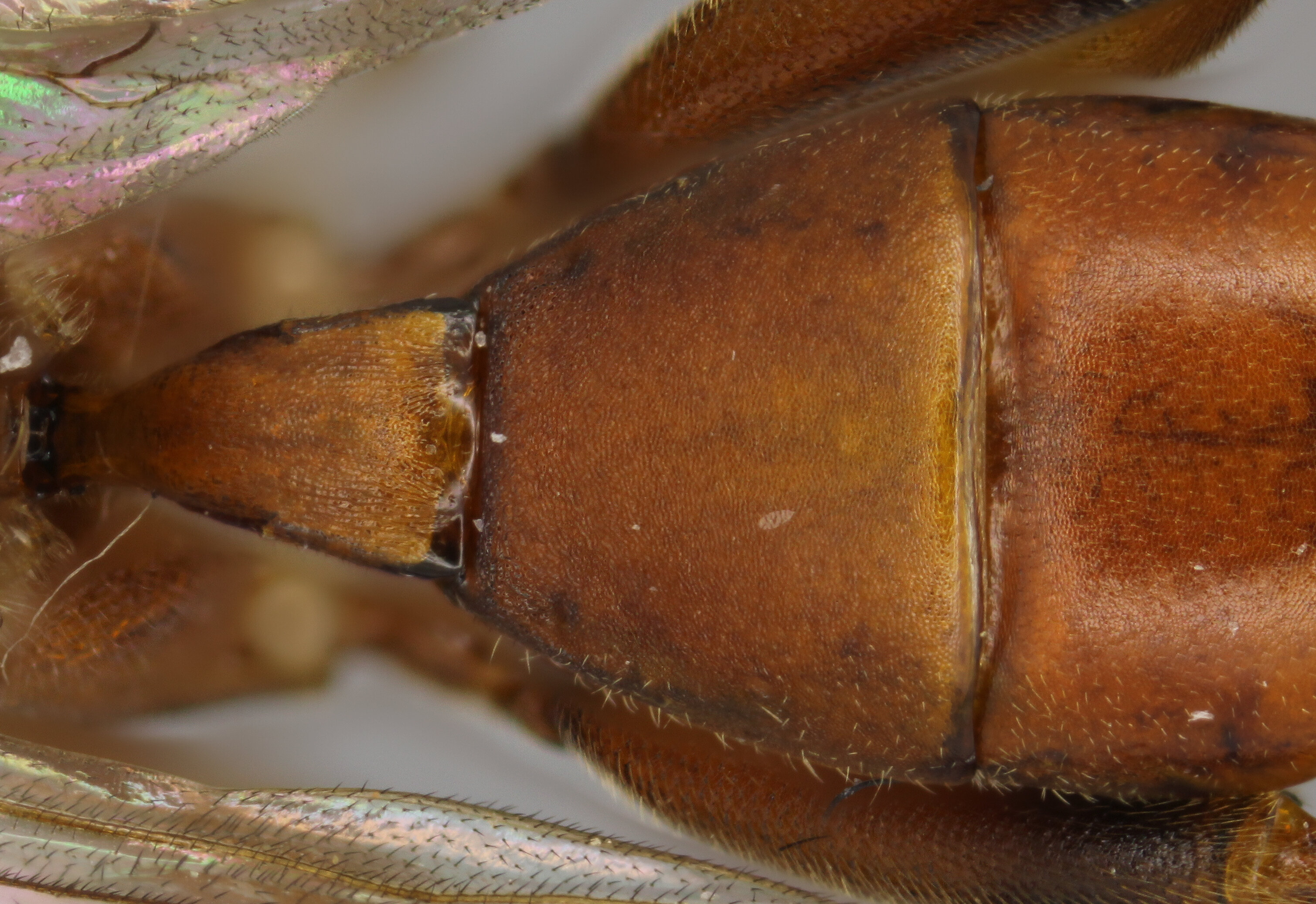
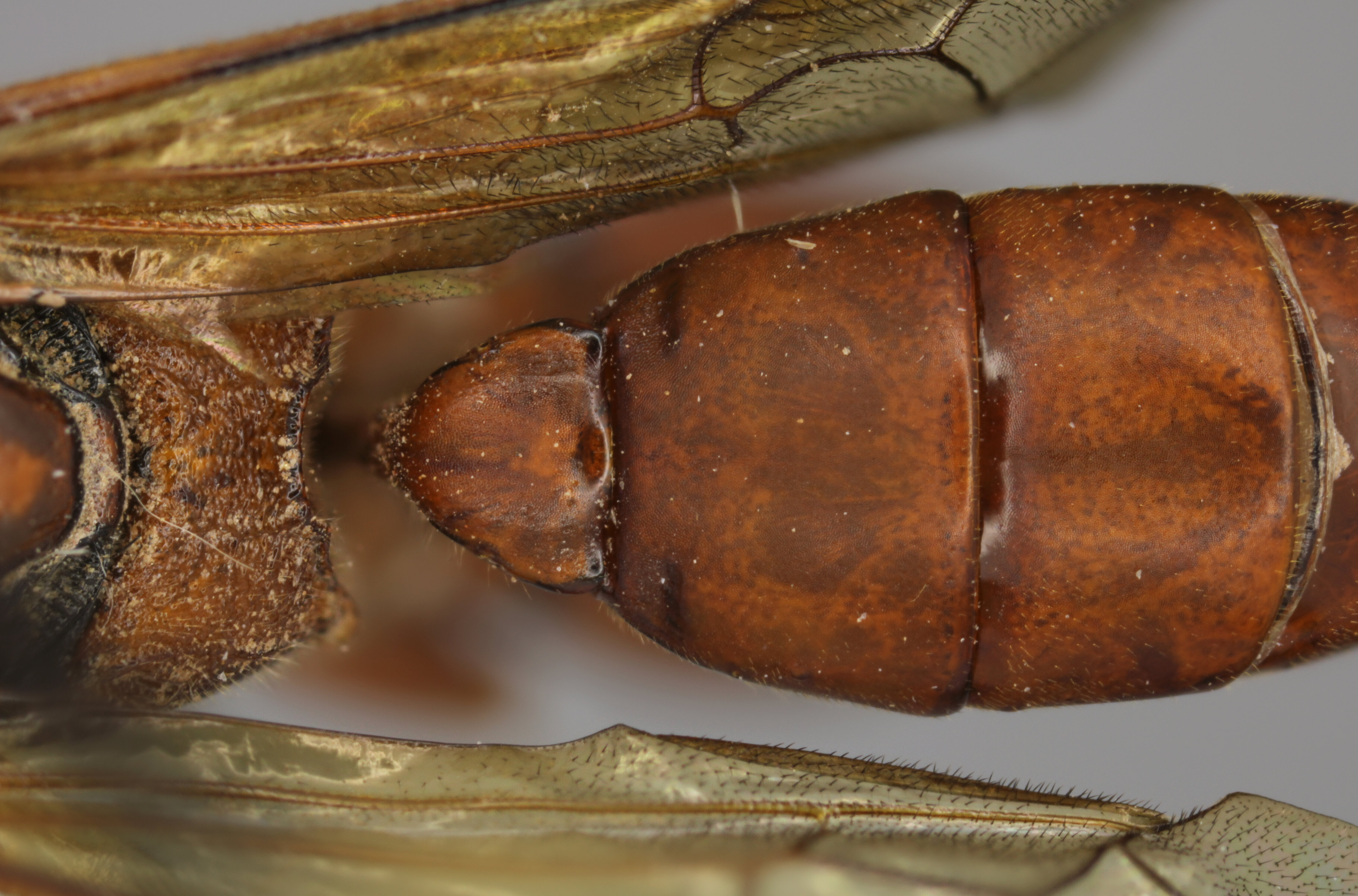
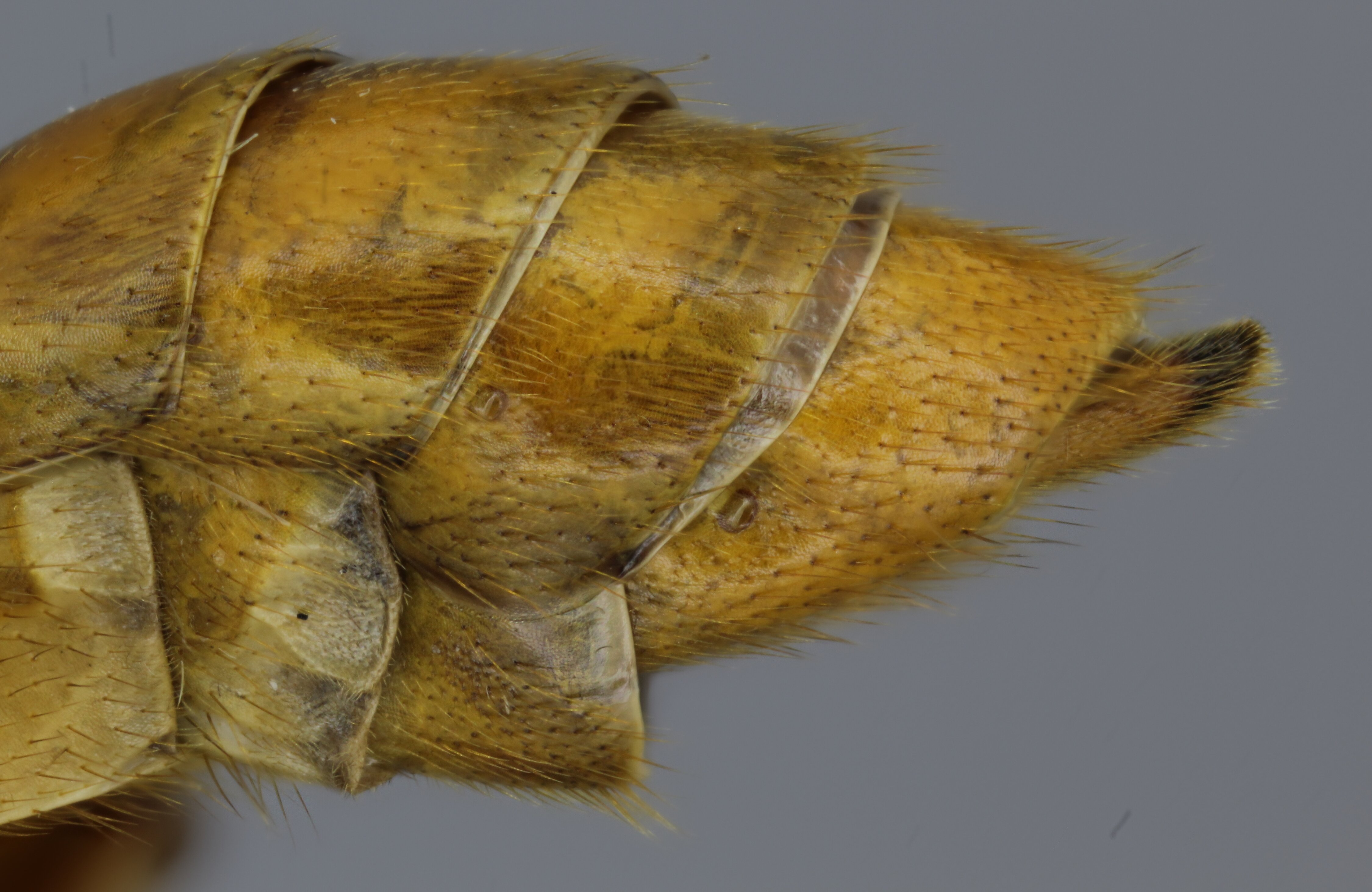
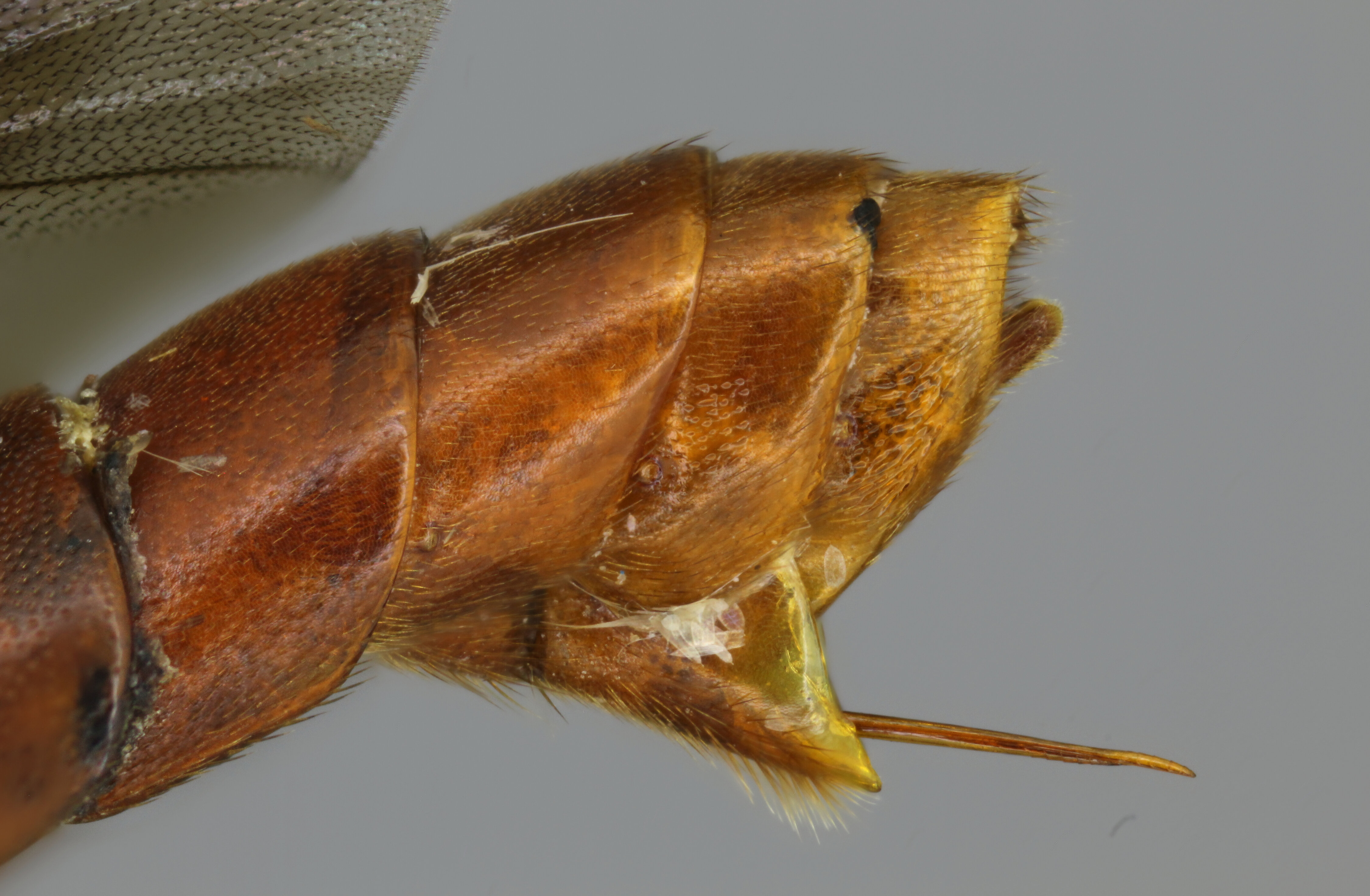
Female metasomal apex
The female metasomal apex (posterior end of the metasoma) varies between oxypygous
and amblypygous, roughly meaning sharp vs. blunt, respectively. This is a major character
used in Ichneumoninae taxonomy but it can be difficult to interpret, especially given the
variation in position in mounted specimens and the fact that there is a spectrum from
oxypygy to amblypygy with an intermediate state of "semi-amblypygy". Several characters
accompany the two extremes: amblypygy associated with a longer hypopygium significantly
concealing the ovipositor with the latter being narrow and needle-like, while in oxypygous
females the hypopygium is shorter and the ovipositor more robust.
While defining
Oxypygous
Female metasomal apex with hypopygium short leaving ovipositor
largely exposed. In dorsal view, metasomal apex appearing sharp or pointed.
Amblypygous
Female metasomal apex with hypopygium longer, partially or
almost entirely concealing ovipositor. In dorsal view, metasomal apex appearing rounded or
blunted.
no image yet
semi-amblypygous
Female metasomal apex intermediate between
oxy- and amblypygous.
clypeus usually flat with straight ventral margin (convex in
Platylabini, Trogus, Hoplismenus and a
few other genera)
areolet usually pentagonal (infrequently quadrangular
or open apically)
metasomal tergite 1 with spiracle posterior to segment midpoint
metasomal tergite 2 usually with gastrocoelus
ovipositor short (usually not projecting significantly past metasomal apex)
male flagellum often with tyloids or sometimes bristleridges
Image size
FILTER MENU
Antennal banding
Fore/mid leg color
Head
Hind femur
Hind tibial banding
Mesonotum
Mesopleuron
Metasoma
White/yellow metasomal apex spot
Wing
Region
State
Country
Anterior propodeal process
Areolet
Bristle ridges
Gastrocoelus
Female hind coxa
Female metasomal apex
Mandible
Propodeal apophyses
Thyridium
Tyloids
Sex
Tribe
Ichneumonini
Phaeogenini
Platylabini
Host family of genus
Host species
Three keys are available here. The tribal key is built for this work and
uses characters visible on whole, pinned specimens. The generic key is
Heinrich's, reproduced from Part I of his Nearctic synopsis; it is more
demanding but covers every genus. The third key is Neotropical rather than
Nearctic: Townes and Townes' key to the genera of Joppini, useful for
southern material and for the many genus names shared with our fauna.
The following generic key is still in development. It is meant to be maximally useful for
non-experts and thus focuses on more easily visible characters.
1. Hind leg black except for brownish-red femur. Habitus as in
image below . . . . Limonethe maurator
(common in open
fields)
- Habitus and color as in image below (i.e., metasoma yellow with
black apex) . . . . Neamblymorpha
milva (Northeastern North America)
- Habitus and color as in image blow (i.e. T1-2 brownish-red and
T3-7 black, female with yellow antennal banding, male without
antennal banding) . . . . Tmetogaster nubilipennis
- Hind leg otherwise. Habitus and color various . . . . 2
- Metasomal tergites normal or clypeus flat . . . . 3
3. Epistomal suture completely absent such that clypeus and
supraclypeal area form a continuous plane. Mandibles short, broad
and with subequal teeth. Propodeum short with areola wider than long . . . . 4
- Epistomal suture at least weakly indicated. Mandibles usually moderately narrow with
dorsal tooth distinctly longer than ventral tooth. Propodeum usually of moderate length
usually with areola as wide as long or longer than wide (infrequently with areola wider
than long) . . . 5
4. . . . . Anisobas
- . . . . Neotypus
5. Areolet diamond-shaped or irregularly pentagonal. Large species.
. . . 6 (Callojoppa genus group)
- Areolet pentagonal. Usually medium-sized to small (except Protichneumon
and Ichneumon devinctor) . . . . 9
6. . . . .
-
7. . . . .
-
8. . . . .
-
9. Propodeum with spine-like apophyses
. . . . 10
- Propodeal apophyses absent or at most dentate . . . . 14
11. Mandible sickle-shaped and unidentate. Apical tergites of female
with anterior unsclerotized. Coloration as in habitus image below . . . .
Plagiotrypes concinnus
- Mandible bidentate. Apical tergites of female fully sclerotized.
Coloration various . . . . 12
12. Propodeal apophyses elongated. Clypeus convex. Overall color
various but never mostly brownish-red . . .
Hoplismenus
- Propodeal apophyses small. Clypeus flat or nearly so. Overall
color brownish-red . . . . 13
13. Anterior margin of propodeum with medial process.
. . . Rubicundiella
- Anterior margin of propodeum without medial process. . . .
Hemihoplis
14. Anterior margin of propodeum with medial process. Postpetiole
often densely punctate. . . . 15
- Anterior margin of propodeum without medial process. Postpetiole
usually longitudinally striate, granulate, or smooth
(infrequently punctate) . . . . 26
15. Areola with medial carina. . . Carinodes (rare,
present only in Florida, Texas, and Arizona)
- Areola without medial carina. . . . 16
16. Females . . . . 17
- Males . . . . 22
17. Flagellum greatly widened and flattened subapically and
sharpely tapering apically. . . . Melanichneumon
- Female flagellum weakly widened and flattened subapically. Areola
of male usually nearly straight posteriorly 18
19. Thyridium and gastrocoelus wide (interthyridial width narrower
than thyridium). . . . Stenobarichneumon
- Thyridium and gastrocoelus narrow (narrower than interthyridial
width). . . . 20
20. Clypeus extremely short and wide. . . . Rictichneumon (rare)
- Clypeus of normal length and width. . . . 20
20. Gastrocoelus more deeply impressed than alternative. Color usually
with extensive yellow areas or primarily black. Metasomal apex normally
marked yellowish-white or yellow. . . . Virgichneumon
- Gastrocoelus more weakly impressed. Color usually brownish-red and
metasomal apex not marked yellowish-white or yellow. . . .
Barichneumon
21. Flagellum with strongly developed bristle ridges. . . . 22
- Flagellum without wor with poorly developed bristle ridges
. . . . 23
22. Postpetiole densely, coarsely punctate. Areola wide and
posteriorly impressed. Gastrocoelus and thyridium close to anterior
margin of T2. . . . Melanichneumon
- Postpetiole predominantly smooth, sometimes with weak longitudinal
striation. Gastrocoelus and thyridium pushed back slightly from
anterior margin of T2 . . . Vulgichneumon
23. Clypeus extremely short and wide. . . .
Rictichneumon (rare)
- Clypeus of normal dimensions. . . . 24
24. Gastrocoelus and thyridium wide (wider than interthyridial width).
Medial paraocular area usually broadly yellowish-white. . . .
Stenobarichneumon
- Gastrocoelus and thyridium narrow (narrower than interthyridial
width). Medial paraocular area same color as remainder of head.
. . . 25
25. . . . Barichneumon
- . . . . Virgichneumon
26. Postpetiole granulate . . . . 27
-Postpetiole smooth, longitudinally striate, or
punctate. . . .
27. Ovipositor long (projecting past metasomal apex). . . .
Crypteffigies
- Ovipositor short (not projecting past
metasomal apex) . . . . 28
- Female metasomal apex oxypygous Propodeal carinae
well-developed.(except for 2 rare
unplaced amblypygous genera from
Wyoming and Utah; except in these genera coloration
either primarily brownish-red or yellowish-white
and brownish-red; extremely rare). . . . . 29
29. Gastrocoelus and thyridium wide (wider than interthyridial
width). . . . 30
- Gastrocoelus and thyridium narrow (narrower than interthyridial
width). . . . 31
30. Mesonotum smooth (polished). Head in frontal view
nearly paralell-sided
(not significantly tapering ventrally). . . . Homotherus
- Mesonotum granulate. Head in frontal view tapering ventrally.
. . . Aoplus
31. Pseudoplatylabus
32. . . . Platylabops
- . . . 33
33. Cratichneumon
- Eupalamus
34. Propodeum sloping (without distinct dorsal and posterior faces).
Second lateral area long. . . . Often with iridescent
coloration.
- Propodeum broken (with distinct dorsal and posterior faces).
Second lateral area normal length . . . . 35
35. Metasoma brownish-red. Male head primarily yellowish-white.
. . . Protichneumon
- Metasoma black or iridescent blue. Male head primarily black
. . . . 36.
1. Mandible unidentate and sickle-shaped . . . . 2
- Mandible bidentate (ventral tooth at least represented by small
notch) . . . . 3
2. Gastrocoeli and thyridia wider than interthyridial width. Scutellum
strongly raised above postscutellum . . . . Heterischnus (present throughout North America)
- Gastrocoeli and thyridia narrow and subobsolete. Scutellum nearly
flat and not significantly raised above postscutellum . . . .
Stenodontus (present at higher latitudes, high elevation
sites in the southeastern U.S., and in southeastern Arizona and
Mexico)
3. 3rs-m of fore wing absent (areolet open apically) . . . . Epitomus (several undescribed species present in
North America despite genus unrecorded from Nearctic)
- Postpetiole varing from smooth
to longitudinally rugulose. . . . 9
9. Gastrocoeli and thyridia narrow (thyridium narrower than interthyridial width).
Female with 7th tergite constricted anteriorly. Mandible with ventral tooth reduced to
small notch. . . . Jethsura
- Gastrocoeli and thyridia wide (single thyridium greater than
interthyridial width). Mandible with ventral tooth not significantly
reduced. . . . 10
10. Female with large projection on ventral surface of hind coxa
formed by the juncture of two carinae. Ventral surface of clypeus
roughened medially.
. . . . Dirophanes
- Female with or without hind coxal projection but
if present then never carinate. Ventral surface of clypeus
either smooth or punctate but never roughened.i. . . . 11
11. Ventral margin of clypeus wide and punctate. . . .Phaeogenes
- Ventral margin of clypeus smooth and always without punctures . . . 12
12. Carina immediately behind mandible strongly elevated
resulting in a deeply excavated area posterior to mandible. Clypeus
sharply impressed. Scutellum flat (not raised above postscutellum). Head
wide and transverse . . . Aethecerus
- Scutellum usually at least weakly convex and partially raised above
postscutellum (some Tycherus with a entirely flat scutellum).
Head normally about as wide as long (some Tycherus with wide
transverse heads). . . . 12
13. Head strongly convex anteriorly. Epistomal suture absent
(supraclypeal area and clypeus forming smooth uninterrupted surface).
Ventral margin of of clypeus sharply impressed (resulting
in what appears to be a double margin) . . . Diadromus
- Head weakly convex anteriorly. Epistomal suture present. Ventral
margin of clypeus variable not impressed. . . . 13
14. Ovipositor projecting significantly past metasomal apex. Surface scultpure
granulate and impunctate. . . . Tereberella
(rare)
- Ovipositor not significantly projecting past metasomal apex.
Surface sculpture at least partially punctate. . . .14
15 . . . . Phaeogenes
- . . . . Tycherus
Genera by species richness
Most species-rich genera
Top genera by species richness.
Regional species richness
Species described per decade
Junior synonyms described per decade
Cumulative species described
Top taxonomic authors
Authors ranked by number of valid species described.
Nomenclatural flux
For each genus, species originally described there (blue) vs. transferred in from another genus (orange). Percentage shown inside orange bar when space allows.
Synonymy by genus
Valid species vs. synonyms per genus. Color indicates synonymy ratio (blue = low, red = high). Hover a point for details.