Most Wanted·No. 4
Amblyteles crudosus (Cresson, 1877)
Large rust-red and black ichneumonine with violet-black wings, described from California in 1877 and not recorded since.
No image of this species is available
| Name | Amblyteles crudosus (Cresson, 1877) |
|---|---|
| Original name | Ichneumon crudosus Cresson, 1877 |
| Tribe | Ichneumonini |
| Type | Lectotype, male |
| Type locality | California, U.S.A. (no further data) |
| Type held at | Academy of Natural Sciences of Philadelphia |
| Known from | U.S.A. (California) |
| Hosts | Unknown |
| On IoNA | Amblyteles genus page |
| Collector | H. Edwards |
| Specimens known | male lectotype (Cresson did not say how many he had) |
| Last recorded | before 1877, California |
Our next Most Wanted ichneumonid, Amblyteles crudosus, comes from California, where the ichneumonine fauna is quite poorly known despite having 65 recorded species. This mysterious species has gone unrecorded longer than any of the others so far, 149 years to be exact.
This species is intriguing because we don’t even know what genus it really is. Amblyteles was once a catch-all for many unrelated species, and this is the last “Amblyteles” species from North America (the others were transferred to other genera). The real Amblyteles is probably only in the Palearctic and Indo-Malaysian regions.
Ezra Cresson described crudosus in 1877 in a couple of lines, then gave a slightly longer description in 1879. The label data is simply written as “California (H. Edwards)”. The collector is almost certainly Henry Edwards, a well known stage actor who spent his spare time on insects and lived in San Francisco from 1865 until the late 1870s. Edwards also sent Cresson specimens from Vancouver Island, so “California” need not mean near San Francisco, and A. crudosus could have come from anywhere in the state. Unfortunately, the description doesn’t tell us enough to know what genus it is in the modern classification.
Cresson designated a male lectotype in 1916, which is in the Academy of Natural Sciences in Philadelphia. The female and the hosts are both unknown.
Recognizing Amblyteles crudosus
This should be an easy species to recognize. The male is about 16 to 18 mm long with violet-black wings and an entirely rust-red metasoma and legs. The head and mesosoma are black, but the face is yellow, and the scape, scutellum, sides of the propodeum, and the mesonotum (except for a central black stripe) are rust-red. See Cresson’s full description on the species page.
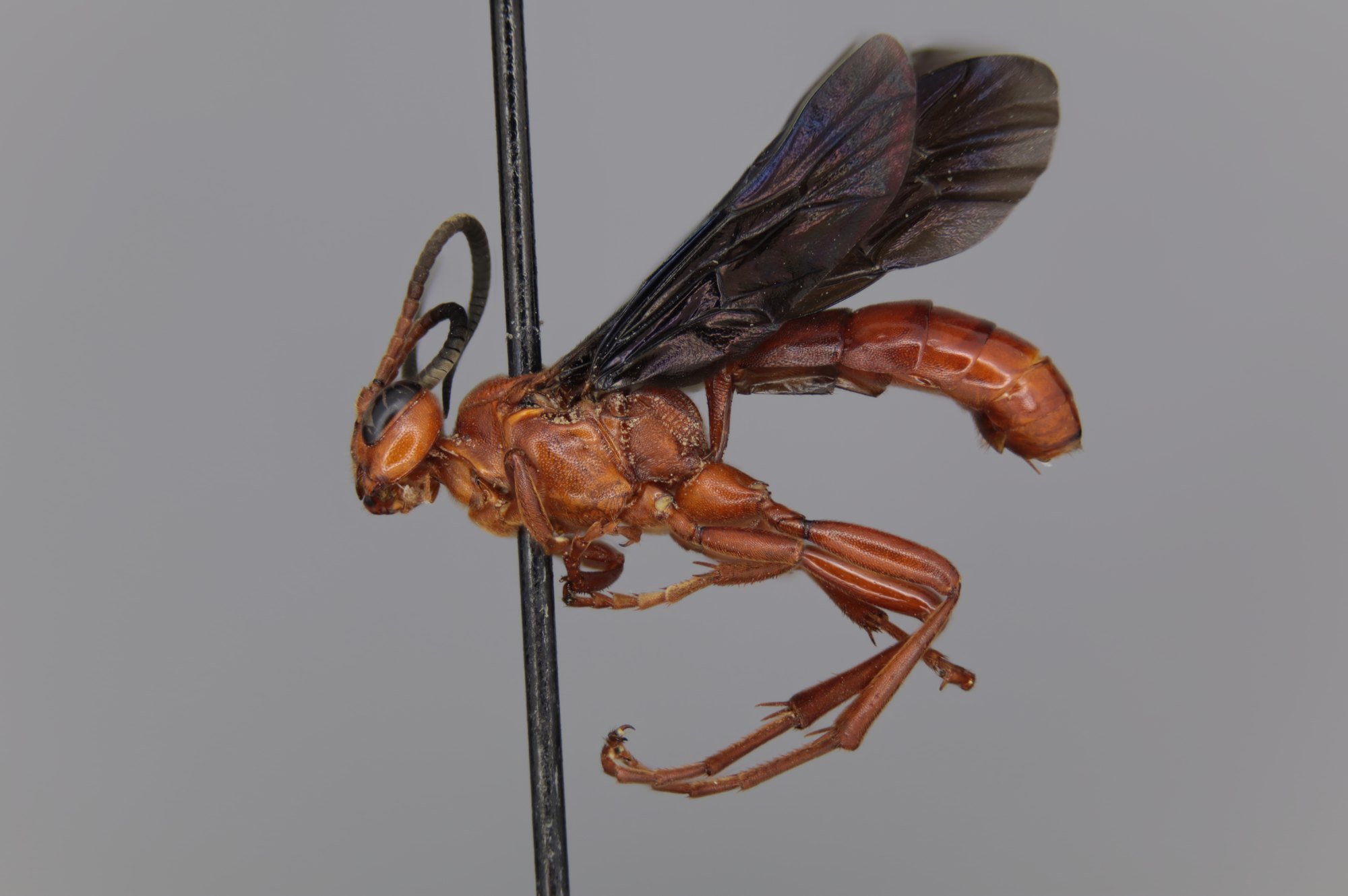
Interestingly, I may already have specimens of A. crudosus. For years, I’ve been aware of an unidentified Ctenichneumon (most likely) from Utah and California, which I have been calling UT10. While researching for this post, I realized that the UT10 males fit well with the crudosus description. I should be receiving photos of the lectotype within the next week or so. One small snag in even calling this species Ctenichneumon is that its mandible is unidentate whereas all other Ctenichneumon have bidentate mandibles (as far as I know). Overall though, between the large gastrocoeli with absent thyridia and the strong bristle ridges on the male flagellum, it matches Ctenichneumon.
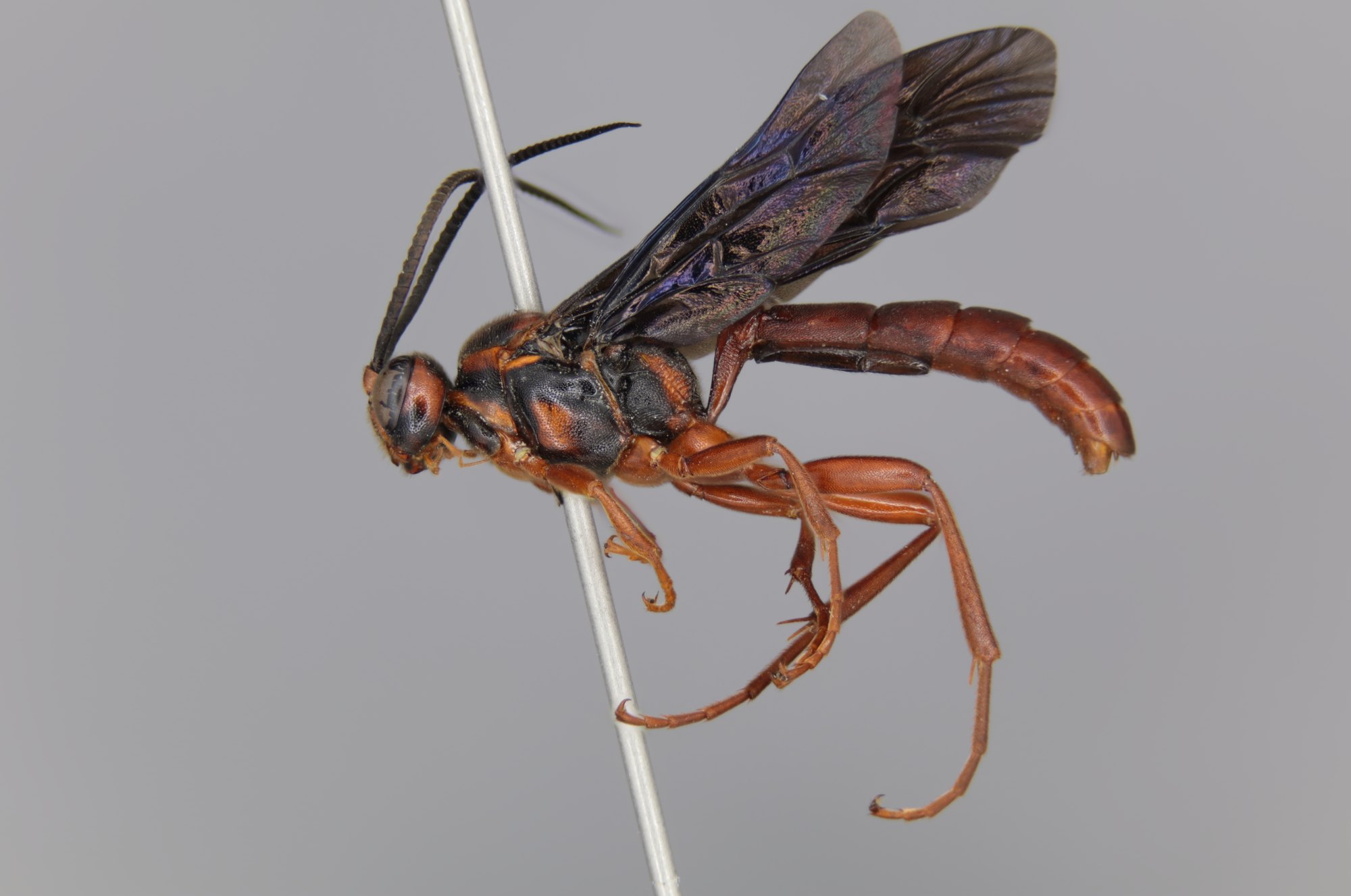
I also have UT10 females. They are almost entirely rust-red, including the head and mesosoma, where the male is black. If UT10 is crudosus, these would be the first known females.
Collecting additional specimens
Without a precise locality or date, there aren’t really any leads on collecting additional specimens. If UT10 is crudosus, then the best habitat to look for this species will be open fields/meadows with sagebrush, mule’s ear, and arrowleaf balsamroot in early June. There was also bigtooth maple and juniper around where UT10 was collected just outside of Green Canyon in Logan, Utah.
As always, crudosus might be present in some Californian insect collection, possibly identified as a different genus.
Significance
The most basic question is what genus A. crudosus actually belongs to. Seeing the lectotype and fresh specimens of both sexes would finally settle this question. If UT10 is crudosus, that will solve a taxonomic question nearly 150 years in the making!